
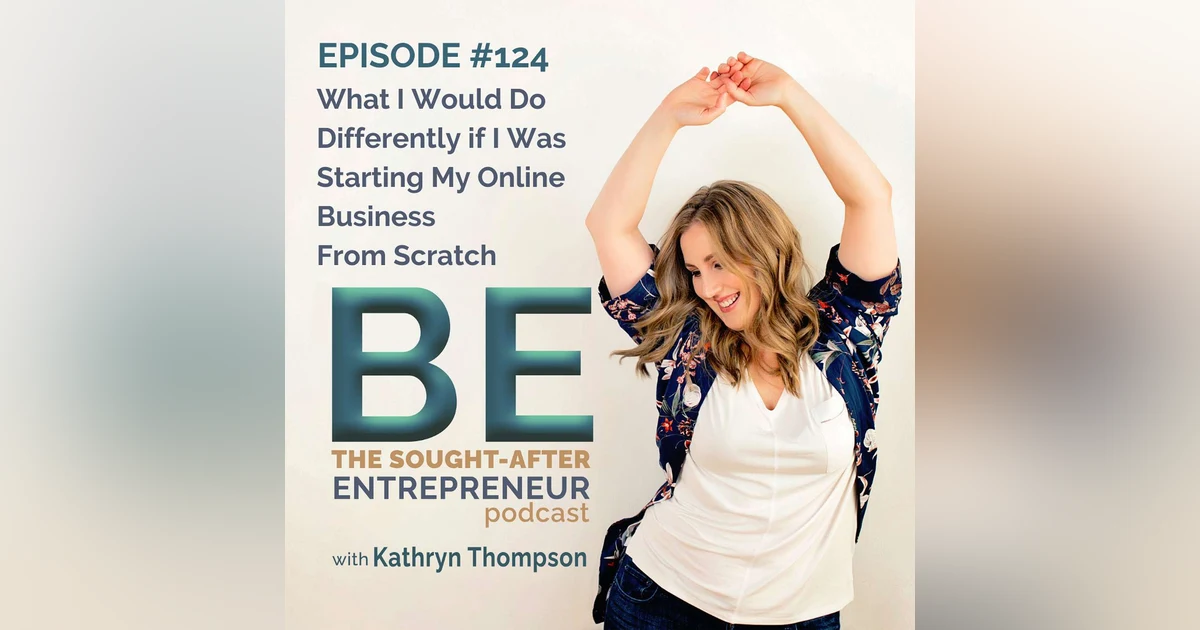
What I Would Do Differently if I Was Starting My Online Business From Scratch

 Apple Podcasts
 Overcast
 Castro
 PocketCasts
 RSS Feed
 If I was starting my online business from scratch, this is what I would do differently knowing what I know now.
BY THE TIME YOU FINISH LISTENING TO TODAY’S EPISODE, YOU’LL LEARN:
- The things that kept me stuck in the wedds in my business without creating any really traction.
- The number one place I would focus most of my attention to create rapid momentum and success.
- Why what seems like a good idea (& the most logical) is often the ones that lead us to just doing more work with little to show for it.
If this episode inspires you somehow, leave us a review on Apple Podcasts and let us know your biggest takeaway– whether it’s created those aha moments or given you food for thought on achieving greater success.
And while you’re here, follow us on Instagram @creativelyowned for more daily inspiration on effortlessly attracting the most aligned clients without spending hours marketing your business or chasing clients. Also, make sure to tag me in your stories @creativelyowned.
Selling the Invisible: Exactly how to articulate the value of your cosmic genius even if your message transcends the typical “10k months” & “Make 6-figures” types of promises.
Free on-demand training >>> https://www.creativelyowned.co/watchnow
To find out how to own your unique edge, amplify who you truly are (& get paid for it), take your business to cosmic proportions, and have fun doing it, grab it here!!
https://www.creativelyowned.com/quiz
INTRO: [00:00:00] After generating over a million dollars in sales and selling one of her businesses with a single email, your host Kathryn Thompson takes an unconventional approach to marketing and sales. So if you're ready to tap into a more powerful way to be seen her and a sought after entrepreneur in your industry without having to spend endless hours marketing your business and chasing clients, you're in the right place. Be the sought after entrepreneur podcast is here to help you ditch the cookie cutter. One size fits all approach to marketing and use your unique energy to effortlessly attract the most aligned clients. When you do this, you can spend less time marketing your business and more time doing your soul work and enjoying the richness of your life. Welcome to be the sought after entrepreneur podcast. And here's your host, Kathryn Thompson.
Kathryn Thompson: Hey, hey, super stoked that you're tuning this week's episode. And I cannot wait to dive into today's [00:01:00] topic because I was recently having a conversation with a friend of mine who is also an online coach and mentor.
And she asked me straight up. She was like, Kathryn. Is there anything that you would change about your journey now that you know what you know now? Like, if you were starting over from scratch, is there anything that you would do differently? And it's such an interesting question because if you've been following me for a while, you've probably heard my very first launch story where I put out an offer, I launched it, I went through the whole launch process with a 5 day challenge and I didn't actually get to the end of it.
I pulled the plug midway through the challenge because I wasn't getting the results I thought I was supposed to be getting and or expected to be getting. And so I thought, Oh, this is just going to be a full on failure. So I pulled the plug and then I sat on my idea for eight months. Doing a lot of things I would never do again in my [00:02:00] business or in any business or Any kind of coaching and mentorship I give to others would be the thing I would steer them away from doing and here's why because No other business would sit on that idea for eight months and not do anything with it.
So that's the first thing, right? You've heard my story about my brick and mortar. Like if I had opened my brick and mortar doors and then sat there for eight months, trying to figure out what I was doing, the doors would have closed because we would have gone under because of the rent that needed to be paid.
We would have had to pay for equipment and inventory and all other things. I didn't have the capacity to just sit there and meddle in my business, which is what I did for eight months. And I'm going to share with you what I would never do again. But I'm also going to share with you some big insights that I've heard big leaders in the industry sharing.
That I feel like deters those that are starting from scratch or those that have years [00:03:00] of mastery in the work that they do, but are now bringing it online, right? Just because you're doing something for the first time online doesn't mean that you don't have the experience and knowledge and what you're teaching and all of that.
I came back into the online space, teaching the thing that I had been doing for 15 years at that point, right, which was marketing and sales. And so when I came into the online space, like I said, I did everything right for the first 90 days. I put out an offer, I planned and mapped a launch, I started to execute the launch, and then I pulled the plug on the launch, which was the first piece of this puzzle that then put me down this spiral of things I would never do again if I actually wanted my business.
To start to take off a hell of a lot quicker and what I did in those eight months is what I'm going to share with you so that if maybe you're doing these things in your business right now and you're trying to get a new venture off the ground [00:04:00] is not really going to help you move the needle in your business but also not give you the evidence that you need the data you need in order to start to optimize and test and see what is working and what is not working or landing right so The very first thing that I'm going to say is, is that having an offer and validating an offer is the first place I would ever start in the first place, right?
With our brick and mortar, we didn't know who's going to come to our doors. We didn't know if people were going to buy from us, but we knew the offer was validated and that there were other stores where we were. That people were buying the same sort of thing and that we knew that if we came in with a slightly different angle, slightly unique position within the market, which we did different product, 100 percent pure juice, we did a bunch of things differently, right?
That positioned us differently. We came in at a very similar price point, even though the quality of the juice that we were using. Was [00:05:00] high, high, high, higher quality than what they were selling. They were using concentrated, which means they added water, which means their wine product at the end of it didn't taste as good as ours.
Now we knew that that offer was validated, right? We just didn't know if our positioning was going to be the thing that would get people through the door, but we were pretty certain that it would. So in the online space. That's the first place that I would start again or even start with any business to be honest with you It's not just online but brick and mortar as well or offline.
However, you want to look at it It's validating your offer. If you don't have a validated offer You don't have a business right if people aren't buying what you're selling You're not going to have a business and where I went sideways and I think I went sideways for two reasons. Number one, it wasn't my primary source of income.
I had a whole other business I was running. And so it was sort of like a side hustle hobby that I was like, this would be cool if I could get it off the [00:06:00] ground. And so I don't think I was approaching it with maybe the same perspective as I was with my brick and mortar. But I spent the next eight months doing something I would never, ever, ever.
Ever do again. And honestly, something I hear really big names promoting that you do. I recently just heard a big name promote that you have to start building your audience if you want to be successful. And this is the one place that I went sideways. I don't disagree that you should build your audience, but what this particular person was saying was that you shouldn't focus on building funnels or anything like that when you're first starting out.
And I highly, highly, highly disagree with that. And the reason being is because I spent eight months building an audience on social media. I spent eight months churning out content, creating content. And selling some things, [00:07:00] but I never really had this offer that was validated because I had pulled the plug on that launch.
And a funnel to me is merely a customer buying journey. And so So I think that that's the thing that we should focus on from the get go. What is the offer? What are we offering? And is it something that people want and, and therefore, what are we doing to test that to figure that out? That's where I would spend 99.
9 percent of my time. If I was starting from scratch again, I would not spend the time, effort and money I spent on creating a beautifully designed website. I would not spend the time and money and effort in the early days on logo design and picking brand colors and scrolling on Pinterest. I would not again, ever again, spend my time energy [00:08:00] on taking courses after courses after courses and consuming knowledge.
Ever again. I'm not saying that I wouldn't learn from people. I'm just saying that I wouldn't have gone down the rabbit hole of consuming knowledge and information. And frankly, information and knowledge I already knew in a lot of ways. Um, I would 100 percent look for specialized expertise in certain areas that were not my zone of genius.
So for example, niching down, doing niching down exercises, doing messaging exercises. Going into programs that teach predominantly how to message and how to market in that capacity from a high level, like who you are, what you do, why you do what you do. I would not spend my time there. I would have spent my time on very, very, very specific expertise.
For example, one, I would be in this energy of validating my offer. So I would have likely [00:09:00] hired or would hire somebody who is an expert in Program design who could support me in creating an, a program that would be laid out in a way that would help me help my clients get really epic results. That was something that I thought about after the fact, because we spend so much time going, how do I market and sell the thing?
And first of all, is the thing even good? Right? And in the core space, I had never created a curriculum, right? I had never taught marketing and sales. I'd already always done marketing sales for other people and was really good at it, but I had never actually taken that knowledge and translated it to somebody else.
So. The first thing that I would focus on would be validating that offer, working with someone specifically on how to articulate the value of that offer, how to package and position it, [00:10:00] how to ensure that it is absolutely 100 percent unique in the industry that I'm walking into, and that I can carve my own space in it, that I'm not an echo chamber of what's already there.
So that's the first place I would really invest time and money in. The second place that I would invest time and money in is how do I actually map out this customer buying journey? And I'm not talking about posting social media content or learning how to post on social or how to write a perfectly curated bio for my Instagram.
None of that. I don't really spend a ton of time or hadn't spent a ton of time writing my bio in the last... Year, right? I don't have highlights on Instagram. I'm not getting lost in the weeds of these like micro things that to me, sure maybe they could move the needle, but to me they don't. I'm like, what is the most direct path to validate that offer?
And that to me is building a funnel [00:11:00] of some sort. How are we building, bringing people into our world? How are we generating leads into our world that are 100 percent interested in what we're selling? And then do I have a product and offering that's going to be able to deliver on what I'm promising and not because I'm not a master in what I'm doing, but is it designed in a way that will get the best out of my students and all the various learning styles they have?
Because When your clients are happy, they come back and you don't need to spend then all your time Having to market and sell on the front end because you've got this beautiful retention Strategy in place that keeps people coming back, which is what we did exactly in our brick and mortar I would literally emulate what we did in our brick and mortar time and time again because we set that business up So, well, we were positioned.
Well, we knew our product was different. We designed our store differently, so it looked different than any other store out there. We [00:12:00] had exceptional customer service. We had exceptional product delivery. We had a beautiful guarantee for people. If they weren't satisfied, then they could come back and we would broom another batch.
We. We treated our people that invested in our product so, so, so, so well, so they wanted to come back. And we focus less on trying to get more people in the door, although we were doing that with word of mouth and some, you know, organic marketing to some degree. But we focus there first. And the reason I say that is because in the early days of your business, do you have the capital investment?
to be putting a ton of money out into marketing and sales and all of that on paid ads, whatnot. Right. And are you putting a ton of money out on paid ads when you don't necessarily have a validated offer per se? Now, like I said, we did put money to paid ads in the [00:13:00] early days of our brick and mortar, but we knew on grand opening day that we had a validated offer because we had.
I don't know, 50 people come in and start a batch of wine on the very first day of us opening. Might have been more than that. It was insane, right? And we had done no pre marketing and people I don't even think knew we were opening. Like we kind of told family and friends and people just flooded our store.
So what I did in the first eight months, like I said, my online business was, I got my logo. I meddled around with the branding colors. I meddled around with what content to write on my website. I got all my tech sorted. I bought my domains. I did all of those things that didn't really move the needle and then I also spent tons and tons of tons and tons of time posting every single day on social because that's the message that was Being sold left, right, and center [00:14:00] that you needed to post five to seven times a week, basically, if you wanted to build your audience.
And within the first, I don't know, three months, I had grown my Instagram account to well over a thousand. I think it was at almost 2000, 1500 maybe. Um, and so I saw this like instant rapid growth in that I was like this new brand that had started and within the, like three months I was well over a thousand people already.
And I was like, Oh, wow, this is cool. As I'm looking around at other people who were starting around the same time as me, who were sitting at, you know, that like 100, 200, 300 people. I was like, oh, wow, cool. This is awesome. But at the end of the day, If you're not building an audience of people who actually want the thing you're selling, it doesn't matter.
And that's kind of what was happening. I was putting out content talking about marketing, talking about life and mindset and all of the things that I talk about, but I wasn't certain [00:15:00] on who I was serving and what offer I was actually giving them and what promise I was making to them when they went through the programs that I was putting out there, right?
Or at that time hadn't put anything out there. I think the very first, um, offer that I had like had in my mind that very first launch was called like the Launchpad and I was gonna support newbies or people starting from scratch who had no clue where to start and how to start. And I was going to give them what I had learned in my brick and mortar, but I wasn't necessarily speaking to them, right?
I think at the time I was just speaking to Entrepreneurs in general, and I was talking about a bunch of things on social that probably weren't super specific to my newbies or people starting from scratch, and so I had built an audience of people that. We're not going to be an aligned fit for the offer, which is the backwards way we [00:16:00] want to go.
Right. And potentially, this is why this big name said, you know, you don't want to build a funnel. You want to build your audience first, you know, maybe from her perspective and the way in which she was sharing it was She was sharing it from the perspective. Like you already know your offer. The problem is, is that when you're new to online business or entrepreneurship in general, you don't necessarily aren't taking that with that assumption in mind.
You're, you're filtering that through your lens of like, Oh, she's telling me to build an audience. And she's telling me not to focus on funnels or building any of that sort of stuff out. And like I said, to me, that is just absolutely backwards. I do get that particular funnels are sophisticated and can bog people down and all of that.
But the very first mentor I had was like, go out and launch, you know, build out. A five day launch challenge or do a webinar or masterclass. Like his whole preface [00:17:00] was build the funnel. You know what I mean? Build your audience while you're launching your offer because you're doing it simultaneously. And.
I don't, I didn't listen to him, I think, all the way through, right? Because I was so traumatized, I think, by the five day challenge that I did that I pulled the plug on, that I was like, oh, I can't get back up on that horse, you know? Where his whole motto was, like, get back up on the bloody frickin horse, you know?
Like, who cares? If you fail, fail fast and fail forward. And I've said that a few times on my podcast. And it was, you know, the thing that I never really took into consideration. But, I felt like I got distracted with all the shiny objects of the things to me that don't move the needle. Um, getting hung up on how to, you know, write that bio for Instagram or how to create highlight reels on your Instagram or how to, you know, have a.
Beautiful logo or what should I name my company? What should the company name be? What should the program name if I offer one? What should that [00:18:00] be? What should my instagram handle be? You know all of these things that I spent months on like do I name my company my name or do I name it something? Totally different like creatively owned and I went back and forth for months on that which is just such a waste of time Right.
It's like just make the decision and go like you can't get it wrong I never went with my name and at the time everybody else was going with their name. I went with an entity right creatively owned And there's no right or wrong, you know, I'm as successful as somebody that has their name as their brand.
Plus my name is long, Catherine Thompson. Like it is a long name. It's not like some little short name like Jen Smith or you know what I mean? That's, that's short and snappy and. Could be a really great IG handle. Not saying that long names aren't, it was just, um, and Creatively Owned is a longer typed out name, but, you know, they're, these are the things that I think we get like so hung up on in the early days.
[00:19:00] These details, these micro details that to me, um, Don't move the needle and are just probably a way for our brain to stay safe. Probably a way for us to just stay in our little comfort zone, right? Like, ooh, that launch was scary. I pulled the plug on it. Ah, shit. Where do I go? And what am I really good at?
I'm really good at building and meddling with stuff as a distraction from the real work that needs to happen. You know, like, oh, I need to get a ring light. And I need to order that ring light. It's got to be a big one so that I can do these lives. And Oh, I need to have like, you know, this beautiful backdrop in my office for these lives.
Like I've got to have wallpaper. And I remember looking at like different type of wallpaper and my husband's like, why are you getting wallpaper? And I never ever did. But I remember him thinking like, you know, What's the wallpaper gonna do for your business in general, right? Like is someone gonna look at you on camera and go?[00:20:00]
Oh, wow She's got like really cool brick wallpaper a really cool flower wallpaper Like nobody's saying that I literally have the whitest of white walls behind me, you know And this is where I take all my sales calls. This is where I do Anything I'm really doing or if I'm, you know, sitting on my couch, the ad that's performing the best for me right now is literally me sitting on my couch, my living room.
These are the details to me that don't matter in a lot of ways. We overthink them, right? Um, you know, where should I film it? How should I film it? What should I say? And I get it. Our brain wants to know the answers and I get it. I come with a lot of marketing and sales experience, but I literally will just grab my phone and just start to talk like an invitation to come into my world.
And I think that to me is like, The best I'm sharing this because I, like I said, I went down this rabbit hole of needing to get all these details. Do I go on Kajabi or do I go on some other platform like teachable? Do I, [00:21:00] you know, what, what do I do? You know, like what's, what tech should I get? What email provider is Kajabi going to be good enough for email?
Um, You know, scrolling on creative market and Pinterest for colors and logos, um, digesting more and more content, looking at more and more and more content. Oh, crap. Oh, I need to learn how to actually use Instagram. Do I really? No. You know what I mean? Like again, there's, there's people that are going to sell you a formula on what works and what doesn't work, but I haven't followed anybody's formula for Instagram.
And I'm telling you straight out that like. I've built a highly successful online business without that. I've built a highly successful business without having highlights. I've built a highly successful business without having some manufacturer curated bio, right? Haven't changed my bio in well over a year.
I I've created a highly successful business with out having some. [00:22:00] Logo created for me or anything like that. I've created highly successful business without everything sort of matching, you know, having all the matching colors or curated feeds or curated anything, you know, and again, when I think back to my brick and mortar and I think back to grassroots companies and businesses that start, it usually is scrappy.
Right? You start with this sort of this scrappy mentality where you're like, I'm just going to take action and do the thing. It's going to be messy. It's going to be, you know, not necessarily maybe the best all the time, but it doesn't matter. People are, people gravitate towards flaws. Right people grab it's proven scientifically.
It's proven. It was proven. Somebody wrote a book called the instant appeal and In there, she literally had market research and data and years of data where people would naturally be gravitated Towards the flaw in somebody or something Their eye would catch it and they would gravitate [00:23:00] or there would be this deeper level of self, this deeper level of trust that would happen when, when somebody presented a flaw and she did this whole case study on a gentleman who was on trial.
I don't know if he was on trial for murder or fraud or whatever, but he was on trial and he was. A bigger gentleman and maybe a little scruffy and not well put together and he was on trial and the jury, I think, found him not guilty and there is a study that like the jury will find people more likely not guilty if they present some type of flaw, which is why you'll often see people dressed down who are on trial for murder, right?
Like if you actually look at a murder trial. And somebody was like this bombshell or always put together out clubbing or whatever their lawyer, defense lawyer will tell them, like, I want you your hair [00:24:00] down, maybe in a ponytail. I want you to wear glasses. I don't want you with any makeup on, like, watch it.
Right. You'll see people sitting on trial. You don't see people walking in with like, You know, Gucci or bling or their hair perfectly blown out. And the reason for it is because trust is built when people have some type of flaw. And I'm not saying that makeup or anything like that is portraying that, you know, that that shows.
And I'm just that when you put a makeup on, you're covering your flaws, right? You're covering your real skin and you're, you're portraying this perfectly polished poised way. And I'm not saying that's bad. I'm just saying that there is proof research wise, that juries will look at people and have, will find them not guilty more times than not when they present a flaw of some sort.
And I'm sharing this with you because. Like I said, we can get so lost in the weeds of the [00:25:00] building and the tweaking and the meddling and that to me is not the thing that's going to move the needle. And so if I could go back and wave a magic wand and start from scratch again. I would double down on my offer.
What am I offering? Who am I offering it to? Why am I offering it? And if I don't know, and I'm not certain, I would do what I needed to do to be certain. And the way in which I would do that, number one would be market research to some capacity. Do I have people in my network that I could talk to and connect with, that I could ask questions about, that I could say, Hey, this is what I'm thinking.
What are your thoughts? You know, is this something that you even want? That would be first and foremost is getting really clear on what that offer is. And I would do that, like I said, through market research, or I would put it out there to people that I knew would benefit from it and go, Hey, this is what I'm doing.
Would, do you mind going through it at a lower cost or free for a testimonial? Um, so [00:26:00] that I could get some information about the delivery of it, the benefit of it. It did it actually work to people see micro wins or big wins, like really, really doubled down on that offer. The second thing that I would not do again, again, is, is mapping out and creating and going overboard on creating this.
Perfectly curated curriculum. I would go in with the mentality and mindset of, I know I can refine this. And I know I'm going to have to refine this. And the reason being is, is because I'll just share it even with Spellbound. I put Spellbound out into the world and it was. The way in which I worked with my one-to-one clients, I didn't a hundred percent know how that would translate to group, and so I created it and there was a curriculum there, there, but I'm in the process now of like really refining the shit out of it.
And the reason for it is because I've got people that have gone through it who have created really great [00:27:00] results, but I'm like, how can I make this easier, faster, and better for them? And it doesn't mean that what they've got was shit and that I sold something that doesn't work. That's not the, that's not the idea.
The idea is, is you can always refine it. You can always make it better. You can always add more to it. Again, with our brick and mortar, we started and our whole primary offer, we had one offer, right, was that we sold pure juiced wine kits for people. People would come in all the time for the four years. I had it and they'd go.
When are you gonna do beer? When are you gonna do cider? What about accessories? And we were like we're doubling down on the signature primary offer that we have and we're gonna make this so freakin good And then when we're ready if we're ready We'll add in more things, but that doesn't have to happen today.
Let's get really good and let's have really happy customers with the one main offer that we have. And then when they come in and they start asking for things, we [00:28:00] can consider offering it because we know they want it. We've got an audience sitting in front of us going, Hey, I really love wine, but I also like beer and I also like cider.
Do you plan to offer anything like that? Right? Versus going, okay, I've got to have this offer and then I've got to have all these other five offers mapped out and then I have to build them all out before I can launch because I want to have an upsell and a downsell and a side sell. And I think that is absolutely backwards.
Because you have no clue what they actually really want per se, right? You might know on that primary offer. All of the other offers might change in relation. To what you receive and what you hear from those customers. So I would double down on one primary offer. I would do what I needed to do to validate that offer, market research, launch it, put it out into the world, put it in front of the right people at the right time.
So I can get some real data of what's working, what isn't working, why people want it, all of that. That's where [00:29:00] I would start first and foremost. And the funnel that I would build would be, I would either launch. In order to receive the right people going through my world based on the offer I am selling not based on like content I'm just putting out on social that Most people just wing their content anyways and don't really have a content strategy So just putting content out there for visibility To build an audience of people that may or may not ever buy an offer from you because you actually haven't Got the clarity on your offer to me.
That's just a waste of time The other place I would not spend any of my time is like meddling or finessing a logo, brand colors, any of that stuff. I would move very, very quickly on that. Pick colors, run with it. Letters on a website, it doesn't have to be a logo. Trust me, I have creatively owned and black writing on my website.
It's, there's nothing fancy about it. I would not focus on the details of the things I think I needed like ring lights or, [00:30:00] you know, a better camera to take video or some type of video editing software that's gonna make my videos look way better, like, I would not waste my time at all there. My, my priority would be selling the offer, refining the offer, selling the offer, refining the offer and how I chose to sell it.
I would put people through a funnel of some sort, whether that's a five day challenge, a masterclass, a three part live training series, some type of freebie. Maybe I have a quiz, whatever. I would build something that pulls people into my world based on the offer I'm putting out there and I would sell the shit out of it.
And then I would refine it so that more and more people that come through are happier clients and customers. And then I'd focus on nurturing my existing customer base. I'd look at them and go, what do you need? Okay. You need support on this. Let me put something together for you. Oh, you need support on this.
Let me put something together for you. And that's how I would build out my offer suite. I would not build out my offer suites with the notion or idea [00:31:00] that I'm trying to get more clients per se in my world. Or I'd build out my offer suites based on sales conversations I was having with people that were like, Hey, I'm not quite ready for your signature offer.
Do you have anything else that could support me? Absolutely. Okay. Let me put something together for you. That's how I'd build out any other offers in, in response to what people are asking me for. As long as it's in alignment with me, I'm in the midst of building two. amazing freaking offers that are going to support people who aren't ready for spellbound and it has been my friends laugh at me because i've been saying this for months now probably since like february or march i'm like i've got to create these offers for these women who aren't quite ready for spellbound who might not be 100 certain on what their offer is or even how to communicate it because it's Invisible or it doesn't have tangible results or people that are like, I don't quite even have an audience.
How do I grow an [00:32:00] audience that are people that are actually going to want to buy what I put out there? These are questions I've been getting over and over and over on sales calls. And for months and months and months, I've been hearing it and I'm finally getting ready to put something out there to support this particular group of women in my audience, because they've asked for it.
Not because I'm like, Ooh, what can I create? You know, to, to get more people in my world, I'm listening to my audience and going, what do you want? And how can I best support you? Okay, I'm going to put this together for you. It's very, very curated. Spellbound came from listening to a lot of people talk to listening to a lot of women.
Tell me their problems and struggles. Didn't just like, I didn't just create it in my house and then put it out into the world. Like I'd been working with women for two years, one to one. And I'd been listening over and over and over and over again to what they wanted. And that offer was built based on that.
So if you're sitting in your house, again, doing these [00:33:00] exercises in a coaching program or a mentorship, where you've got these sheets of paper that someone's like, what's your niche? And what's your dah, dah, dah, dah, like get in front of somebody. Those sheets and papers and that curriculum style where you're learning and having to do Exercises in the comfort of your own home is building your business in a silo and you can't validate an offer in a silo It's kind of like being in an office Space like it would be like me being in marketing and maybe being in my little bubble and not communicating with like the creative director of the ads department Right.
And I'm like, well, this is my marketing plan and I'm going to go build it. I'm going to go do everything. And then I'm going to just dump it on these people. Like, no, I have to work in relation with them because they see and do things differently than I do. Right. And then it would be like literally putting stuff out into the world and not having gotten any feedback.
I worked in marketing for 15 [00:34:00] years and I can tell you straight up, we always did market research before things ever went out, you know, we had test commercials. With the primary audience and thank God we did because commercials are expensive to produce and I remember sitting in a focus group room with a room full of 19, 20 year old men and we were producing a commercial on drunk driving and how to reduce that amongst that demographic because they're the most likely to drive drunk, proven, this isn't just me speculating, this is proven research in the province that I live and so we were producing a commercial.
Um, And we had this idea of having some type of, like, superhero person whatnot. And we showed it to these men and they were like, No. Like, this is not gonna get my attention. This is cheesy and corny and, like, it's, no. Right? But if we would have gone and produced it, and then put it out there, the reception would have been shit.[00:35:00]
And people wouldn't have responded to it. And yet again, I always look at the online marketing business space and the coaching space and none of this is really being taught, like actually having a focus group. Another one, I'll give you a prime example. I was working with a company and they were producing, um, workout gear.
Let's just say it was on the height of Lululemon. If you don't know what Lululemon is, Google, there are a company that produces like yoga gear, right? And they just absolutely took off like. well over decades ago and I was working for a company that was like not wanting to copy them, but like had this unique idea of retro 80s style workout gear and they had mock ups and sketches done and they put it in front of their primary audience in a focus group and the audience was like, I would never buy that, nor would I ever wear that.
Like go back to the drawing board. But can you imagine if we had not done that? The thousands [00:36:00] and millions probably of dollars spent on producing a ton of clothing. Right. And then trying to sell it and they were going to open a brick and mortar business. Right. So they would have had to the capital to open a brick and mortar to then produce all the inventory of all the different sizes and all the different kinds to even open a store would have been, yeah, hundreds of thousands of dollars, if not a million to get up and sort of running.
And we stopped a train wreck waiting to happen because we put it in front of their primary audience and their audience said. No, we don't take the time to do that in the online space because we build a lot of our stuff in, in silos. We build a lot of stuff in our house because we're taking somebody's program that's telling us this is how you create an offer and this is how you map the offer out and this is how you do it.
And so you sit there with your little workbooks and you work through it. And then when you, you're like, Oh yeah, I'm super passionate about it. And maybe you are. And then you put it out and it's like your audience is like, that doesn't [00:37:00] really resonate. They don't say that to you, you just don't get the response that you want.
And so, I would so double down on the offer. And I would so double down on validating it, and getting real insight on it so that I can optimize it, so I can make it the best damn frickin offer for people, that they actually get the results that's being promised, and they're happy, and therefore potentially come back, time and time again, because of the experience that you've created.
Which then takes the pressure off of having to market and sell all the time. Um, that's what I would do differently. If I could start from scratch again, it would be the most streamlined, simple process, offer, build out some simple funnel that would sell the offer and then serve the shit out of the people that bought the offer and then refine it as they.
You know, share their feedback and know that that's all part of the process. The refinement piece is [00:38:00] huge and the refinement pieces, you know, the thing that's going to help people get better results, faster results, easier results. And knowing that I'm not going to have that perfect. The first time I put it out there, I remember when we opened the brick and mortar business and we had it set up the way that we did, you know, there were things and kinks and things that we had to work out that.
We wouldn't have been able to work out if we didn't have people coming through the store. If we didn't have people bottling wine. If we didn't have people, you know, wanting labels and custom labels and different things like that, which is what we offered. Like, you know, we didn't know the time frame that it would naturally take somebody, right?
So if we were booking people every 15 minutes, we would have been really crammed with people. So... And we probably would have had people then waiting because we weren't done yet. So like it's all these kinks that you work out and the only way you work it out is when you're trying and testing and actually having real humans in front of you.[00:39:00]
So I really hope that this episode has helped. You in any way, shape or form, if you're sort of spinning in a circle in your business and you're like focusing on these, what I say, details that don't really make a difference or aren't going to give you quick, easy, fast information about what people actually want and, and how they want it delivered to them isn't is going to save you a shit ton of time and frustration.
Cause that's what I hear a lot, right? I've been trying to do this for. Six months or I've been trying to do it for 12 months or being trying to do it for, you know, two years. And I'm seeing some results, but I'm not, it's hard or difficult or whatnot. And the minute I start to audit or assess somebody's business, I'm always like, well, what are you doing?
Tell me what you're actually doing. And they're like, well, Catherine, can you just tell me what my IgE bio should be? Or like, what should I put in the highlights? Or, Hey, I was just wondering, like, Does this, these brand colors like look good or what do you think they portray? [00:40:00] Like, does the blue portray blah, blah, blah, blah, blah.
I'm like, just like your head's already down a rabbit hole to me. That like is, doesn't make any difference in your business. Right. I can tell straight away when someone's sitting across from me where their head is in their business and where they are lost in the weeds of it and they don't really know.
Where to sort of focus to actually make progress in their business. And again, you're in business, you have to sell something, right? You have to be making sales in your business. So I'm not sharing this to, you know, be. And asked about it. I'm literally sharing it because it's where I spent eight months playing safe, eight months just dabbling because I didn't have the pressure to make it go, because I had a whole other company I was running, so it didn't matter.
But I approached it completely backwards and M for whatever reason, right? And I just don't want y'all to be stuck there doing that. And I also understand how much noise there is in the [00:41:00] online space. And when you look up to these gurus, and I'm talking gurus with like hundreds of thousands of followers or like thousands, tens of thousands of followers who are saying like, focus here and focus here if you're starting new.
And then focus here. If you're like well established and. I'm not saying you don't want to build an audience, but it really irked me when I heard that because I was like, you're going to send so many people in your, in your world down a rabbit hole. They're going to be on social writing content because she said nothing about an offer.
She said nothing about selling an offer. It was like, You've got to nail your messaging or your content creation. If you can't create content that creates engagement and response and traction, you're going to have a hard time selling. But I'm like you're gonna have a hard time selling if you don't have a bloody offer.
You're going to have a hard time selling If you don't have an offer, you're going to have a hard time selling If you don't know how to position that offer. If you don't know how to communicate the value of that offer, you're going to have a hard time selling anything. And [00:42:00] Oftentimes if you're selling the invisible or you have a service that feels not as tangible.
I hear this often It's so hard to sell it Catherine because it's not tangible. It's not like a product like wine Wine is kind of a no brainer either like it or you don't and you maybe you drink Enough of it that you don't want to spend A ton of money at the liquor store that we do for wine. So you're gonna want to get it for cheaper.
It's a no brainer purchase. I don't really have to sell it. Services in the online space, it's saturated, it's noisy. These are all the things that I hear. And I get it. And I get it. But it feels saturated and it feels noisy because we're spending our time pumping out content like a machine. I call it like factory farmed content, right?
It's like just turning out content and following these templates and scripts of like, boof, boof, boof, I'm putting all this stuff out there and I'm hoping that like this just builds visibility and awareness and people want to come work with me [00:43:00] and. At the end of the day, if that isn't an ecosystem that's driving people somewhere to an offer, to a freebie, to a masterclass, then it's just like a billboard on the side of the highway.
And how many of you have driven down the highway where you live? Or even being in a big city and seeing a billboard and actually pick the phone up because you saw a billboard that had a phone number on it that you then pick the phone up and said, Hey, Joe, I saw you had a cleaning business and I'm looking for a house cleaner.
Like, have you ever done that? I've never done it. I see billboards all the time. I've never once, ever, ever, ever once picked my phone up. I'm not saying they don't work. I'm just saying I've never done it. Right? So. I'd be curious if you've done it and that's to me what social media is in a lot of way.
You're pushing out content like a billboard. How are you actually pulling people in? How are you actually like calling people [00:44:00] in like a door into your business? And what are you calling them into? Like think of it like a brick and mortar, right? If I had a signage on the front of the door and then they opened the door and there was nothing there, there was no wine, but the sign said custom winery.
And I, and they walked in and I said, I'm not quite ready yet. I don't really have it. I don't really know what I'm doing yet. I'm just trying to like finesse my logo. It's a waste of time. Right? So that's what I would do differently. If I was starting from scratch, I would double down on that fricking offer.
And I would get so good at delivering it and so good at marketing it and packaging and positioning it. So that it is a no brainer. So that I actually don't even need social content per se. That I could put it out there to the right people and they would buy it because it was like me selling wine. It was so tangible, even though it wasn't [00:45:00] tangible.
They could see the value and why they'd want to invest in it. That I didn't even need to put posts out there. That I could just literally say, this is how I'm going to help you. And they say, yes, please sign me up. And then I have this beautiful offering that I offer them that to me. Is where you want to start is does your offer create the value that you don't even need to market?
That's a game changer. And then you can get good at creating content and then you can get good at all of the other things, but it's like that offer piece is huge. So with that, I'm going to leave you. Yeah. And I really hope that that has been beneficial and giving you some insight and. Really, I think the biggest thing that you can take away from this right now is just like, pause for a moment and ask, where am I in the weeds?
Like, where have I spent a lot of my effort and time in the weeds? Am I finessing a [00:46:00] logo? Am I looking at ring lights? Am I trying to find wallpaper for my wall so that my videos look great? Am I like researching video software so that I can edit it in the best way possible? Am I looking for apps on social of like how to make the best curated reels that look professional?
Like am I spending my time on this stuff that to me is not going to move the needle? Again, like look around and look at people that have built successful businesses, but look at people that have built successful businesses in sort of like what I call like that scrappy way. Some, again, when you look at the big name gurus, it's really easy to look at them and go, Oh wow.
Like look at all of the stuff they're doing, but they will be the first to tell you they never started there. They never started there. They didn't start with the overly produced live launches. They didn't start with the. Perfectly curated brand visuals and imageries and photo. They didn't start there.
They started from [00:47:00] the scrappy. We just don't see it. And so I'm trying to remind you that like you can start in the scrappy part of your business and start there and still be really successful, but you have to have an offer that is articulated in a way that shows the value of it so that you don't actually have to market it.
That it becomes a no brainer purchase just from the packaging and positioning of it. So, with that, I'm going to leave you. If you loved this episode or if you have any questions about this, please pop me a DM over on Insta at CreativelyOwned. I love connecting with you all. And obviously if you've loved this episode, please leave a beautiful review.
That really does help the show. Until next week, I hope you guys have a fab day! Cheers! Thanks for listening! We'll see you right back here next time. You can also find us on social media at creativelyowned and online at creativelyowned. com Until next time, keep showing up as your [00:48:00] authentic self!


