
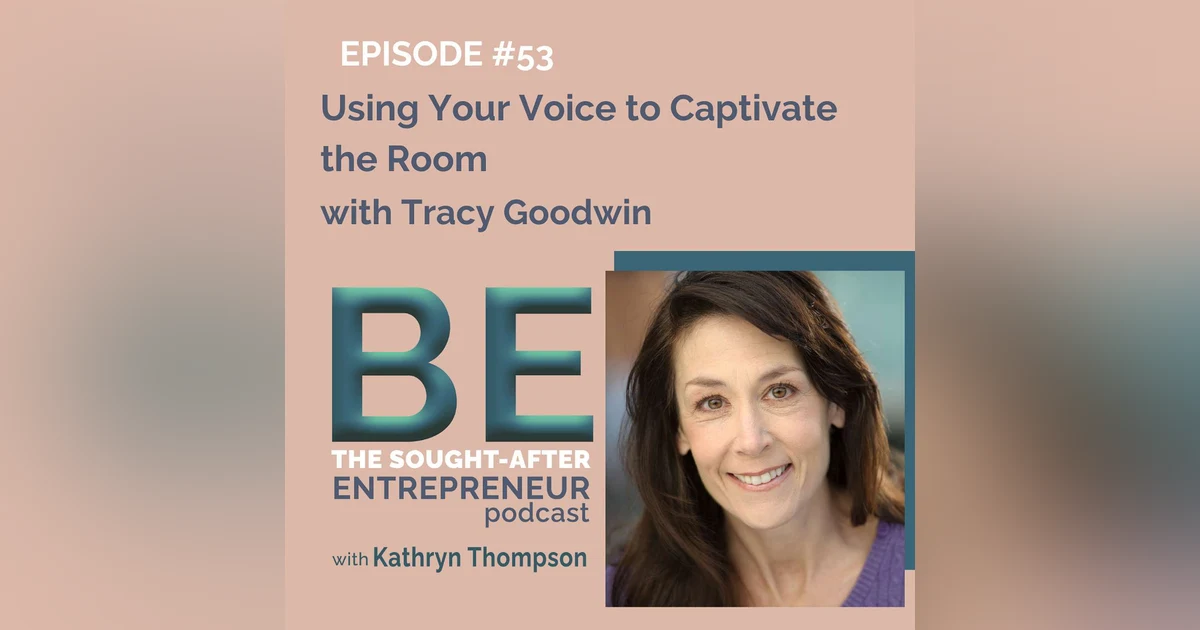
How to Use Your Voice to Captivate the Room with Tracy Goodwin


 Apple Podcasts
 Overcast
 Castro
 PocketCasts
 RSS Feed
 Ever wonder why your message falls flat or doesn’t resonate with your audience even though you know it’s awesome?
In today’s episode, Tracy Goodwin shares how the sound of our voice influences our audience.
Tracy Goodwin, owner of Captivate the Room and creator of Psychology of the Voice has transformed thousands of lives around the globe. With her unique approach coupled with her laser-sharp intuitive hearing she unravels limiting voice barriers and finds the real voice, the sound of your soul.
So if you want to learn what the sound of your voice is really saying, tune into today’s episode.
BY THE TIME YOU FINISH LISTENING TO TODAY’S EPISODE, YOU’LL LEARN:
- The common drivers behind our voice that are preventing our dream clients from working with us.
- How our voice is impacting the way our audience receives our message and if it lands with them.
- Practical steps to bust through the voice barriers to truly connect your real voice with the sound of your soul.
If this episode inspires you in some way, leave us a review on Apple Podcasts and let us know your biggest takeaway– whether it’s created those aha moments or given you food for thought on how to achieve greater success.
And while you’re here, make sure to follow us on Instagram @creativelyowned for more daily inspiration on how to effortlessly attract the most aligned clients without having to spend hours marketing your business or chasing clients. Also, make sure to tag me in your stories @creativelyowned.
To apply for Elevate, an experience for coaches & consultants wanting to craft & scale their offers that sell on autopilot using attraction marketing, click here!
To find out how to own your unique edge, amplify who you truly are (& get paid for it), take your business to cosmic proportions, and have fun doing it grab it here!!
https://www.creativelyowned.com/quiz
To connect with Tracy:
INTRO:
Hey hey, Kathryn here! I’m so glad you’re tuning in. If you’re new to the show, welcome. I’m so glad you’re here. If you’ve been around for a bit, you know I’m all about keeping it real with you. Showing you all the sides of entrepreneurship (& life). I mean it’s all connected, right?
Tracy Goodwin, owner of Captivate the Room and creator of Psychology of the Voice has transformed thousands of lives around the globe. With her unique approach coupled with her laser-sharp intuitive hearing she unravels limiting voice barriers and finds the real voice, the sound of your soul.
So without further ado let’s welcome Tracy to the show!
Kathryn Thompson 00:00
Hey, hey, Kathryn here. I'm so glad you're tuning in. If you're new to the show, welcome, welcome. I'm super stoked that you're here. If you've been around for a bit, you know, I'm all about keeping it real with you showing you all sides of entrepreneurship and life. I mean, it's all connected, right? Speaking of real life, if you hear some buzzing in the background, I've got some people well, I don't have people but there are people outside near my house, mowing the lawn or trimming a hedge or something like that. And I don't blame them. It's a beautiful, gorgeous day where I am in Canada at the moment. We're finally getting some summer-like weather which we absolutely love this time of year. And that means everybody's out working in their yards and yes, even on a Thursday afternoon, that is what day it is when I'm recording this intro into this podcast. I'm sitting in my home office, looking at the beautiful plants I've got they keep growing and growing and growing. So I've repotted I've got some babies repotted. I'm just super stoked. Who knew, right? I used to kill plants all the time. And now seems to be I'm like a green thumb over here. I don't know. I won't jinx it. Just joking. Anyways, I am like, really freaking excited for this episode, because I have on a very special guest who has one of the most unique freakin gifts I have ever come across. And when I was connected with her, I was like, Oh, my God, I have to have you on the show like 100%. Because everything that she talks about the mission that she's on is so much in resonance with what I'm doing and the mission that I'm equally on. And I just am like, so excited for you guys to hear what she has to say. But essentially, I had put up my quiz. I don't know a couple of months ago now. And somebody had taken it. And they reached out to me in the DMS and they sent me the most thoughtful message and feedback. And just were like, oh my god, I finally feel like I have permission to like, just do business my way and to take strategies that are really aligned with me, and that feels good for me. And she's like, by the way, you need to connect with Tracy Goodwin because she's doing very similar work to you, but in a very different way. And Tracy and I connected right away. As I said, I was like I need to have you on the show, because Tracy and you're going to hear from her and she's going to share with you even more. But Tracy has this innate gift, this laser-sharp intuitive hearing where she can actually hear when you're speaking through your voice. Whether or not there are limiting beliefs or subconscious drivers behind why you're saying what you're saying and how you're saying it. It's all to do with the sound of your voice. So if you've ever delivered a talk or gone on live on social media, or you're in your stories on Instagram, let's say and you're putting out this like the kick-ass message, and you know, your content is good, you know, it's transformational. You know, it's life-changing. And yet it continues to fall flat with your audience. And you can't really figure out why and you're like, I know my message is good. But for whatever reason, it's just not resonating with my people. Will Tracy has this laser-sharp, intuitive hearing that can actually pick up what the sound of your voice is actually saying or landing on the hearts and in the minds of your audience. And for most of us, all of us, we all have what she calls, masks, voice masks that we put on, and stories that we tell ourselves that actually impact the sound of her voice. She's the owner of captivating the room and creator of the psychology of the voice and she's transformed 1000s of lives around the globe with her unique approach. Like I said, that is laser-sharp, intuitive hearing that helps us unravel the limiting voice barriers that we all have and finds that real voice. That's the sound of your soul. Like, honestly one of the most innate gifts. I'm so excited to have Tracy on the show. And without further ado, please welcome Tracy to the show.
Kathryn Thompson 00:03
Hey, hey, I am super stoked to have Tracy on the show today. Tracy has one of the most unique gifts that I've ever come across. And I'm just, I can't wait for her to share with you what she does for entrepreneurs. So without further ado, I'm just going to turn it over to you, Tracy so you can share with our listeners, who you are and what you do.
Tracy Goodwin 00:24
Well, I'm so glad to be here with you today, I just am thrilled that we were connected. And that's probably the hardest question you will ask me during our time together is who you are and what you do. And in a nutshell, I can use the term I'm a voice coach, but people who understand my work, say Don't ever call yourself a voice coach. That's not what you do. I've heard terms like voice coach on steroids, voice, whisper, and even Identity Finder. But what I do is I teach people how to uncover, I can hear the layers of blocks and barriers to the real voice that has been put in by the subconscious. And I know we're going to break all this down. But basically, I pulled the layers away so that people can speak with their real voices. So they can maximize their following their retention, their revenue, their internal freedom, their confidence, and there, of course, the ability to captivate the room.
Kathryn Thompson 01:29
Love it. And I know, you know, we were connected in the DMS, which I absolutely love the online space. I had put out a quiz a month or so ago now and someone had taken it somewhat a client of yours and connected us. And so I'm just so grateful to be able to have you on the show now because like I said, you have one of the most unique gifts that I've ever come across. And I just absolutely love the work that you're doing. So I don't think you're a voice coach. And so yes, when people tell you don't call yourself a voice coach, because it's so much more powerful, the work that you do. And so I want to dive into that, because I know the listeners are like, okay, so how can you uncover the blocks? Like, because you're hearing it right? I hear? Yeah, you hear it? So, share with our listeners, you know, what that is? Like, I guess what you're hearing is you are there types of blokes, are there things that you're hearing? Okay,
Tracy Goodwin 02:27
sure. And I'll just start riffing. And yes, redirect me if I go on too long, or if you want to go in a different direction. But I want to tell a little bit of the backstory because I think this is important for anybody that felt like they maybe didn't have a purpose, or maybe were stunned at what they thought they were supposed to do. Just like me being a voice coach. Yeah, I was raised in a generation where children were to be seen and not heard. on steroids. That's where the steroids piece comes in. I was basically silenced. But I could hear voices. And in a way, I just assumed everybody could hear them. I found acting and speaking and I was an award-winning speaker. By the time I was 16. It was a platform for me to use my voice. And because I had been silenced, because I had not been allowed to say things like any, I had some catastrophic events happen to me early in my life. That shifted my voice dramatically. That put me in front of some of the greatest voice coaches of our time. Wow. So that was the beginning of me really navigating sounds and how our subconscious puts our voice in. It has been a 30-plus-year process. And what I can tell you today was not how it was even 10 years ago. But it's funny because I was talking to a coach of mine a couple of weeks ago, a month or a couple of months ago. And I said, Oh yeah, the seven layers. And she said, What? What did you just say? And I said, Yeah, I hear seven layers. Everybody has seven layers to their real voice, I hear their maximum best voice and that becomes the North Star for me to pull the layers away that are blocking and the blocks become, are you working from the wrong place? I work in sounds the size of a grain of sand. And so I'll hear a sound and I'll say your outcome-driven right? And they'll go yeah, how do you know because I hear it in your voice and it's a missed connection point. It's a layer that's blocking the real revelation of you. So the first the top layers are all the different ways places we're working from. Then I hear the layers of what I now call voice masks. I have researched all of this I have. I've really dedicated my life to it and I call voice masks specific sounds that we pick up and put on literally like a mask, that blocks the connection. They also block the fullest expression of who we really are. And so everybody's layers are different. But what's interesting is everybody has seven layers. And that seventh layer is the fullest, most amazing, extraordinary expression. Yet, what is the world done to us? The world has, and the subconscious has tempered us. Don't rock the boat. Don't be too loud. Don't express yourself, just just sit there and look pretty, you know, little by little, we've put these layers in place. And I take them away because I hear what they are. I can identify them very quickly. And then remove them.
Kathryn Thompson 05:51
Yeah, and it's so fascinating. Like, it's such a unique gift. And I'm always just so blown away every time you talk about it, I'm just like, Oh my God, I want to dive into every little facet. So the seven layers are like the first kind of step. But that's kind of what you hear. So is it like talk to me about like the session or how it happens as you can you hear the seven layers, for example, in my voice right now? Or do you have to be tuned in to that?
Tracy Goodwin 06:19
I have to be tuned in. Yeah. Now, I will say that the other day, I got on the call. And there was a pretty significant tone of condescension. Yeah. And some of the repellent tones. I cannot bypass you. Literally, I had a headache for two days. But generally, and I tell this to people, and I've tried to put them at ease. I say don't worry, I don't have a lot of friends. Because people are always Are you listening? Are you listening to me? Are you deciding? And I'm like, No, I'm not. In fact, if you switch the gears on me right now and said, What do you hear in my voice? I would have to redirect everything I'm doing internally. Right. And so I don't stay tuned in. But when it's go time, yes, I actually can hear in a sentence what the layers are generally. And so the layers, there's the seven layers that become my tool that I work with. But in the psychology of the voice, there are three pillars. And the first pillar is literally that where you're working from, I can tell you if you're trying to get the words, right, I can tell you, if you're thinking about what I'm thinking about, I can tell you if you're outcome-driven problem solver, I can tell you if you're dragging the past and these are all microscopic sounds that I hear and have identified now. So that's pillar one is on and on an earthing, if you will the noise that was put in starting before you were five that's establishing where you're working from. And generally, that's the first two or three layers I hear. Yeah. Okay. And then pillar two is about masking the blocks and barriers that are keeping us from connecting. So I appeal to these layers away of where you're working from. And I can certainly dive into very specific things on that. But then I hit the masks. Are you a people pleaser? Are you a justifier? Are you a condenser? Are you professional? And what people don't realize is my favorite part is the masks. And I I figured this out. When I worked with a man he came to me and he said, Tracy, I think I'm potentially repelling customers. And instantly I said you are? And he said how do you know? And I hadn't even developed masks yet. And I looked at him and I said, What are you trying to prove? These were sounds that I heard in his voice and his face fell. And he said I spent my whole life trying to prove my worth to my father. How do you hear that? And I said it's your voice mask. It's in your muscle memory. Well, needing to prove he was continuing to need to prove and potential customers were going I don't know about that guy. He thinks he's a hotshot or something. See, the potential client is processing the sounds they hear. They don't know the backstory. They don't know what's behind it, they hear a sound and go That guy's a jerk. I gotta go find somebody else. So there are all these different masks that are put on to protect us. So in the corporate space, and I know you're gonna relate to this one I have had a corporate career. We're all professionals in the corporate space. Yeah, we put our professional mask on, and did you feel the bulletproof glass go down? Because you're not going to find out who I am. It's a mask. Yeah. Okay. And it's a protection mechanism. But it completely eradicates connection, because now I'm like the dog in the video. That doesn't know if the sliding glass door is closed, or the bird and I slam into it. And I go, I don't know about her, and I walk away. So that's pillar two. And that's generally a bucket of layers. Because if you have needing to prove you've got defense and arrogance, I mean, it's just gonna happen. Yeah. And then the third pillar, which is I'm getting closer to the heart now is, are you showing me who you really are? Are you? Are you saying, I'm really excited to be here? Or are you going? I'm so excited to be here with you today? Because that's who you really are? Or are you keeping it in a teeny tiny box? Well, you can keep it in that box. But I can tell you what is on the other side of that box because that's that seventh layer. And so pillar three becomes about unleashing all those shades of you that the world told you to stop expressing.
Kathryn Thompson 11:00
Yeah. And it's so fascinating, like I and there are so many points there. And I know my audience and the type of people that I attract those high achievers, overachievers, you know, they've achieved a lot of success in their life, they probably came from corporate to some degree, I came from corporate. And you talked about the first five years of someone's life. So is that where a lot of the conditioning happens? Or do we also equally pick up parts of our identity and what that identity is supposed to be, depending on the career path that we've chosen? Like, I know, incorporate, as you said, you come out feeling you have to, oh, I came out of it after 15 years. And I still know some of my identity is like, I've got to be professional, I've got to be well put together. No one will take me seriously if I'm not buttoned up. And if I'm not speaking a certain way, I'm not using language a certain way. And so I want to talk about the zero to five because I feel like that is that a piece where there's a lot of the conditioning happens.
Tracy Goodwin 12:06
That is the piece where the core driver, what I call the core driver goes down. And I love I think this lands so much better when I give an example. Yes. So so when I had I will remember working with a man, he spoke very quickly. Yeah. So typical voice coaching would say, well, we need to get you to slow down, Bob. And I would go well, I don't know if we do or not. And what so what I go to looking for are the voice stories and the core driver. So when this was a man, well, in age, yeah. And we started unraveling the story. And it turns out that when he was younger, his family would sit at the dinner table, and the kids weren't allowed to talk. And so his dad would then look at his watch and point to the kid and go your turn. And he would have to hurry and hurry up and say everything he had to say before his time was up. And so his core driver was you're bothering me, that was established before he was five. So it wasn't about the speed. There is no amount of coaching that would slow him down. Typical voice coaching until we went Hold on a minute, are you really bothering us? Is that right? So before we're five years old, and parents don't panic when I say this, okay? Before we're five years old, one phrase determines how we're going to use our voice for the rest of our life, why do I call that the core driver, the core driver of I'm not enough or I'm bothering people, or nobody cares what I have to say. That's the core driver. I could have built a new voice story this morning at 10 o'clock. So voice stories, college professors, teachers, siblings, neighbors, Joe, the doorman about a client that has a meltdown, you know, anything that relates to how you use your voice. And it is a negative input. Yeah, create voice stories around. And the voice stories can be you can have 50, you can have 5000, you can have five, that they all tend to feed off of that core driver that says you can't do anything, right? Well, if you've got a driver running in you, that says you can't do anything, right? How inclined Are you going to be to show up and do a video or show up and speak at a conference or do a podcast interview where you're not? Because your voice is linked to? You can't do it right.
Kathryn Thompson 14:55
Interesting. Interesting. And so there's some phrase that happened between like zero and five that actually created the driver behind the voice. So interesting. And there was something else that you talked about of like over, you know, you were like people pleaser over justifying those sorts of things. What does that look like? When someone's talking like an over just a fire? Sure, example? Sure.
Tracy Goodwin 15:20
Let me say something to your, to your listeners about the voice stories, because what's going to start happening? If it hasn't already in our time together? Yeah, you're going to be cooking dinner, and you're going to hear that phrase, you're gonna, you're gonna hear it. And this happens every time I teach a workshop or do training or something. I mean, three-quarters of the way in somebody's typing in the chat. Oh, my gosh, my second-grade teacher told me I couldn't color right, or whatever it was. Yeah. And so don't be surprised if you don't start hearing these phrases in these stories. But these are sounds. So let's say, justification. Justification is a mask. The justification goes like this, instead of me saying, let's let me think of a scenario real quick. Let's say, you ask him, I want you to come on my podcast. Yeah. Instead of saying, You know what, Kathryn, I would love it, if you would come on my podcast, I'd love to interview you on my show. I go, Well, you know, I have a, I have a lot of audiences, I have a, I have a really good successful show. And, you know, I've got a lot of experience. And I have done this for many, many years. And I my audience is very faithful, it's very loyal, they come back, they really download, you know, my numbers really reflect that I've got the same people that I've got a good following, I've got a really great, and I go on and on and on justifying how my show is good enough to warrant you showing up on it. Yeah, instead of just going, Hey, you want to come on my show. And part of why we do these masks like justification and prove and people please and convince, and everybody get ready, buckle up. Because this is where you, this is where you don't like me anymore. We believe from conditioning, that we can control the outcome. So if I am trying to control the outcome, which is I want you on my show, but I have a driver that says nobody wants to come on your show, I'm going to pick up that justification mask, because I believe that that justification will get me the outcome that I want. And I've missed all my power. Because of my power, we cannot control the outcome. But I can control the conversation by the way I make you feel. So my power is in making you feel what it's like to be near me. And beyond my show who I really am. That is what is going to make you go oh my gosh, I'd love to come on your show. Not any amount of justification. Or let me convince you why on good enough for you to come on my show.
Kathryn Thompson 18:23
Yeah, and it's so beautiful. That whole feeling right? And we think about how we're actually making the person feel. But we're actually doing the opposite. When we put on these masks. That's what I try to prove when we try to convince when we try to justify why we're good enough, basically, right?
Tracy Goodwin 18:45
And it's it really voice in my world. I think the reason the woman there was a woman many years ago, she started it she said this isn't voiced this is identity. You helped me find my identity. And I really think that came from voices worth. Yeah, voice is the representative of my soul. Voice is the utmost place of judgment. The minute I open my mouth science has proven that in 30 seconds, you've already decided everything about me. So if I come in with a condescension, you've made a decision about me, and it's probably not going to work in my favor. But this is the this is so here's another example of people-pleasing. Yeah, I would say 80% of the world are people pleasers. And you think well that's not a bad thing. I'm nice to people I'm helpful. So let me give you an example of a gal that was losing million-dollar deals. Wow. She was a people shouted people pleaser mask. She would go into the pitches and be neutral because she didn't really know what they wanted her to be. So she would come across like this delivering her information which the superpower the true superpower is And I can tell you how you're being processed in the subconscious of the listener. So people-pleasing mask was being read as indifference. Well, they're thinking, well, we like her stuff. But we got to find somebody with a passion to have these million-dollar deals because she thought if I'm neutral, I'm not gonna rock the boat, and they're gonna hire me. No, no, they're not. They're seeking passion and fire and grit and all these sounds, people are seeking sounds, and we put on masks to neutralize them. And then we wonder why they go away? They're seeking sounds.
Kathryn Thompson 20:42
And does the receiver of those sounds know what they're seeking? Or is it completely subconscious where they're they just like, something feels off? Or I don't really resonate or buy? Yeah, no, this person doesn't seem, or they're making maybe an assumption based on the mask, right? Like, I don't feel the passion. I need someone who's got fire and grit and passion. And I'm seeing indifference like how does the receiver hear the sounds?
Tracy Goodwin 21:10
So the majority of this is going down subconsciously. Okay, I did this, everything I talked about, pretty much I've done research on, or I've studied the research. So years ago, I coached actors a lot. That was really the beginning of the psychology of the voice. And I thought, I wonder why the casting director picks the one they pick, you go in an audition room, and it's freaky, everybody looks like you. Right? And, and they've all got the same talent, they've all got the same ability. I thought, Why does one get the role? Because I believed it had to do with voice. So I did a research study on casting directors. And yes, indeed, voice has something to do with it. They hear the sound of the character based on what the producer is looking for. So yes, they're looking for chemistry. Yes, they're looking for a certain look, but they are seeking sounds that represent what the producers looking for. So I took that into the entrepreneurial space. Because I thought, I bet we're seeking sounds. And so again, I'm going to give you an example. Because this just makes it crystal clear. I already know if I hire a workout coach, I already know what I need to hear in his voice or her voice. One, that can't be mean to me, too. They have to be nice, but not so nice that I can't manipulate them when I eat a bucket of ice cream. Okay, so there are specific sounds that represent what we're looking for, and what our experience has been. So if I know that I could manipulate somebody that's going to let me off the hook. I'm seeking subconsciously, I'm seeking that sound. And that's what we do. Based on our own experience, based on what we pick up we're looking for, does this person get me? Has this person walked my path? Is this person ahead of me on the journey? Is this person do they know what they're talking about? We hear all of that, in microscopic sounds. And so if everything's neutral, and everything's like this, I if I'm seeking somebody that's lit up, I'm going to go, yeah, not my person. Let me go over there and see, see, let me have a discovery call with her. And this is the danger when we don't show up as who we really are. And my data shows me, that we're leaving a third of our audience behind. Why not? I'm not talking about the people that aren't our people. I know if you're thinking well, they're not my people anyway. No, I'm talking, taking eight-figure entrepreneurs and making them nine figures, because we started rolling in more sounds for that third of the audience that liked their work. But was sitting there going, I don't know. I don't really know. And I don't really even know why I know. I don't know. But the minute we plug in the sounds of the heart, the sounds of expression, the whole game changes because those are the sounds I'm seeking.
Kathryn Thompson 24:32
Yeah. And it's so interesting and fascinating that a third and I knew, I'm glad you touched on the whole thing about, you know, well, that's not my audience, and they might not be for me or whatever. Because I know that's can be an easy reaction, right? When it's like, well, if they don't like the way I sound, then they're just not for me. And in some cases, yes, that might be true, but you're saying there's a third of the audience that you're leaving behind because they're subconsciously not connecting with the sound of your voice and why I started this podcast was, you know, because I felt like the marketing space was missing exactly what you do in that we spend so much time putting together these cookie-cutter strategies and launching and writing, putting into words what you know, selling through our words written word, when in reality 93% of communication is like nonverbal. There's the nuances, the tone, right? The body, language, all of that, but plays such a factor in whether or not people we're going to resonate with you, and whether or not a message is going to land with them. So when people have these layers and these masks on, how do we start to uncover or take them away?
Tracy Goodwin 25:54
Right, well, I think that I want to add something in on what you just said as well, about that third, and then I can talk to masks and take them away. We also have aversions, everybody has an aversion to a sound. I bet, right now you can think of what you cannot handle listening to. Yeah. And it might be something like fast or slow or loud. Again, I did a research study. And I discovered that everybody has an aversion to an element. And interestingly enough, it's linked to their story. Their core driver, so I can't handle loud, that's my version you loud at me the whole time I'm out, okay, now you can be loud with me, but you got to give me other things. It can also be in affected voices, like, valley girl, valley girl voice that we pick up because it's cool, you know, and some people can be I can't listen to that. Or people that like, you know, like, so like, you know, like, Okay, we have all these versions, these effective voices as well, that can be part of that. Third is that you're playing the same note, you're playing the same affected voice, and you're playing the same mask. And it might be that you pick up a mask occasionally when you feel insecure. Or it might be that you live behind a mask. And I'll give you an example from my own life. And my listeners get exhausted hearing me tell stories about this. But I was ready to hire somebody this last week. I knew what she was charging high. I knew how expensive it was, I was sitting on go. And the degree of condiment con dissension that came out of her voice in our time together, made me fold my money up and see elsewhere. So she left 1000s on the table, whereas a mask of condescension come. I would guarantee you she doesn't even know it's there. Yeah, it comes from insecurity. Just like my needing to prove guy. Yeah. Am I good enough? Oh, you've done this forever. Look at who you've worked with, Oh, I'm not, you know, whatever. There are always those stories. And we pick these things up. And so really, the first thing to do is to really get aware of what you do. Yeah. And that's the hardest part. You know, for some people, they know they'll go Yeah, I'm a people pleaser. I know that's coming out. Right? Or they'll say all I'm and I am a defensive, I get defensive. And so the first thing that we need to do is figure out what we're doing. And if you can't figure it out yourself, go to somebody, you know, like and trust and say, Hey, have you know, what do you pick up when you hear my voice? And you gotta go with somebody you know, like, and trust because that's the only people that are gonna go well, yes. sound kinda condescending. Right. I mean, everybody's not gonna say that. Yeah. But I think we have to take radical responsibility as well. I have to be willing to go, yeah, I get defensive. When I get scared. I get defensive when I'm in a room with people that know more than me, or whatever it is, we have to be willing to do this work first of all, and then the question becomes why? Why am I doing that? It's, it's really just that simple. When we can see what we're doing, and then ask ourselves, why. Why am I doing that? Because you're bothering people. You will hear the sound. Ask the question, you will hear your subconscious tell you the story that's behind it. And then you ask the question, is that ultimately true? And remember, ultimately true is every single solitary time. So very little is ultimately true. Yeah, I used to think high was and then I shrunk a little bit. So there's very little, that's ultimately true. And so then we have to start working from a different place. And that place is about being enough is where that place really is. And so one of the fastest ways for me to override a mask is you start talking to everybody, like, you know, like and trust them.
Tracy Goodwin 30:35
But the object of the game, even right now, the object of this game for me, is I'm focused on serving you. Because if I can serve you and your listener, I'm not over here thinking, Am I doing a good job? And do they like me? Am I saying it right? Am I getting it? Right? I wonder if they're gonna reach out to me. I wonder if that you know, I wonder if Katherine's happy? She brought me No, I'm not there. Yeah, and so my voice can work. Because I'm grounded in my body. Because it's not about me. It's about you and your listeners. And so if we can flip that script, and hone in on, I have to serve these people, I want to serve these people. If I can make this about you. I'm not going to be in my head thinking about how I have to be something I'm not.
Kathryn Thompson 31:26
Totally, totally. And it all goes back to being attached to the outcome, right of like being attached to what is going to happen on the other side of it. Right, I find showing up for a podcast, and I'm a guest on a show like thinking about like you said, you know, are the people going to reach out to me is Kathryn gonna, like, what I'm talking about is, am I going to stumble on my words? Do I write my making sense? Am I giving good enough examples? Like, it's, it's that what we think or perceive, people are thinking maybe too, but also that whole thing about the outcome of what we actually want? And does that boil back down to like the drivers like the driver in your voice of, of why you're doing what you're doing? Like, why you might start questioning yourself or all of the things,
Tracy Goodwin 32:18
we've definitely and it's a bit of a tangled necklace isn't that the driver and the stories play into the habits that are created, and the masks that are picked up? Right, but the world teaches us to control the outcome. This isn't it. And I know this is not your audience. But sales trainers have been trained wrong because they are trained to drive them to the outcome at all costs. And I hear within five lines, you've lost connection because you're not in your power source, which is I'm going to create an experience for you. But the world has taught us and Okay, here's another one, and people get really riled up. Really, really rattled. When I say this. I teach my people not to read the room. What is the world teaching us to read their faces, look at their body language, see what they're thinking? adjust accordingly? How do I know what you're thinking right now? I don't unless I asked you, and you could lie. Yet, I'm gonna turn myself inside out and be what I think is going down instead of being the best version of me. And that is as simple as stopping deciding what we're thinking. Stop controlling the outcome. There is no power there. The power is right. And the only way your voice will work is right here in this now. How do I want Catherine to feel about this time with Tracy? That's it. Yeah, that's it.
Kathryn Thompson 34:02
Yeah. And it's so true about, you know, reading the room, right. It's like trying to read the room. I was on a sales training, sales call training a while ago, two years ago, and that whole mimicking the energy was something that was being taught, right? If somebody's Lohse soft, started, and if someone's leaning in, you should lean in, and if someone's leaning back, and I just remember thinking to myself, in that moment, again, is that we're being trained to be someone we're not because and I love the whole personal trainer thing too, because when I think about the personal trainer and the type of personal trainer, or even any fitness thing, I'm not the overly hyped person. I'm not I need somebody who is going to push me I need somebody who's going to be nice to me, right? Call me on my BS when I'm pushing back and being a bit of a rebel and holding me accountable but also I The rah rah cheerleader has just never been my vibe. And so in the marketing space, oftentimes we're taught to be rah, rah high energy. Oh, yes. And I get so many clients that come to me and they're like, Catherine, I'm just not this rah rah person, like, can I still build an amazing business? being exactly who I am not having to change parts of who I am. And I love that, you know, what you do is tell people to be that Be yourself?
Tracy Goodwin 35:32
Well, I mean, it makes me crazy. It makes me crazy, exactly what you're talking about. And I think it's an incredible disservice to introverts. Yes, I think that you know, just to take the cheerleader rah rah, and I can combine it with this vocal matching thing. Okay, I work at a really high vocal energy, you figured that outlines very passion and very intense. So if I was going to go, oh, well, I've got to start my video ramped up. That's what they're teaching, I would become the ShamWow. Guy. Okay, who wants to hear that? Right. And so you take an introvert that may or may not work at lower vocal energy. And, and we've got this cookie cutter, you got to ramp it up. You got to rev it up at the top of your video. And they're going, Okay, this feels ridiculous. Yeah, well, the same thing is true with a client. Let's say I'm Miss intensity. And let's say you're not, but let's say you're low low energy. What have I just done to myself? My true essence of who I am, if I come and start going, Hey, Catherine, I'm glad to be here with you. See how that just changed the whole experience? Because it's not who I am. Totally. But I was following the model. I was following the training. And the training, throw it out. The training is who are you? What is the best version of your vocal energy? What is the best version of your expression? What is the best version? Right? Say, I don't even you know, when people come work with me, I'm not even I don't want you to be me. Yeah, you're not me. Who are you? We got to find out who you are, and find the best of all of those shades. But it doesn't work when you go to cookie-cutter vocally. Because I'll show you what happens when it when you do and want everybody to feel how you would like literally feel what this experience of us having this conversation is like, and now feel the experience of what the conversation is like, everything totally changed, didn't it? But I don't want to I don't want to be I don't want to rock the boat. I don't want to be dramatic. Because I was told I was too dramatic voice story that I was too dramatic. So I'll just be that you feel the connection just gone dissipates? Yeah, it's a feeling. That's that feeling where after? I don't I don't understand words and language like your genius does. But I do know that the right words strike a feeling and someone. Yeah, so do tones of voice. But they have to be your tones. Because if they're the tone, somebody told you that you have to be you're not connected with them. If you're not grounded and connected, you're giving me nothing to connect to. Yeah.
Kathryn Thompson 38:46
Yeah. And it's it's so true. It's like throw the rulebook out and just just take the radical responsibility is obviously the first step of like, doing the work. Because if you don't even know you're coming off it, let's say indifferent, and you're a people pleaser, or you're coming off as arrogant or condescending, right? It's like, you've got to turn the mirror back on yourself and take a hard look in the mirror and actually want to do that work. Because if you don't even know you're coming off, let's say arrogant or whatever. Or say you do you know you're coming off as arrogant. Right? It's like you don't, that's a hard thing to maybe swallow. Right is like
Tracy Goodwin 39:26
realizing that. Yeah. And I think that the power in the realization is not. This is where I think people get such an aha moment when they hear the depth of what we're talking about here. Maybe they did know, they get insecure and they feel defensive. But did they realize how that was vocally costing them? Right at you know, I do think at times we know maybe we didn't know the voice piece, but we know we feel insecure or We know we feel, Oh, they're better than us, or, Oh, I've got to act like a big deal. We feel those feelings internally. And I will guarantee you, there's a sound with it. That's probably not working for you.
Kathryn Thompson 40:16
Interesting. So with Qantas, like being condescending or arrogant, what's the mask there? Like what happens usually to people when they have that it's because sometimes it's righteousness, I feel like righteousness. Even in language. When people have posts up, I'm like, I feel like there's this like, righteousness energy behind it. I'm right, you're wrong, or what you're doing is wrong. And I always just get so turned off by it. And I see it a lot in marketing, right? Because we're taught to be polarizing and to position ourselves differently. And so how do we do that we make ourselves right and somebody else wrong or we make our strategy right and somebody else's strategy wrong. And so how does that sound? And then also, what is the underlying mask there? Like, where does that come from that righteousness?
Tracy Goodwin 41:13
Well, I think, again, it's a little bit of a tangled necklace. And I was thinking about my condescension, girl, as you were talking about that. And then I was also thinking about many, many years ago, when someone would give me resistance and challenge what I had to say, Ah, okay, and it became a purse, it became an attack on my identity. Yeah. And my worth was built into my capability is part of it. And I think a big part of it is about my, it's very much worse. But a big part of it is about I have got to be right, because I have got to be important. I have got to be right. Because I have got to know more than you. I have got to be right, or I have nothing. And so this to go back to this example of the condescension was very fascinating to watch it going down. And it really, it really threw me sounds like that will throw me out when I'm paying for things especially. Yeah, but it was very much this for a there, okay. What you're doing is okay. Which is why don't you just say, what you're doing is not working. See, and we fear directness, we directness, has a bad rap, I would have much rather. So for this person to have garnered my business. I know what I'm seeking. I know what my failures are. I needed nurturing. And I needed to know that it was okay that I hadn't done it, right. Yes. And I didn't get that I got. Yeah, you could do it that way. Because you're an idiot, and you don't have a clue what you're doing. It's a process to that. And so it really is a projection of her own insecurity, and her own needing to be better than it's a needing to be better than I have to be better than you. Because that's the only place I'm worthy of. There's a book by Carol Dweck, I believe is her name. It's called mindset. And it's about a fixed and growth mindset. And it very much aligns with what I'm talking about here. This person had this armor, I think of masks as armor, I feel them as armor, I, the second they come down, I bang up against them, right? I physically feel them, sometimes I see them. And this armor becomes this protection of you cannot find out who I am. Because then you may not like me, or I may not be good enough, or I may have gotten it wrong. Or maybe I don't know what I'm talking about.
Kathryn Thompson 44:12
Yeah, and that whole identity piece again, I think when we're as entrepreneurs or professional corporate people, right, and we're hired to do a job or as entrepreneurs, if we're a business coach, let's say or something we're selling a service or a product of some sort is like, we're the expert. And so we've been trained or conditioned to have to know it all and to have all of the answers. And if we don't, then how
Tracy Goodwin 44:39
good are we? Right? Well, it becomes this either-or trick bias. And you know, I love that word expert and I will I use this example all the time because I work with people of all ages, but a lot of times I'll work with an intern group. Yeah, they're still in college. They're 20 they're 21 and they This will come up and they're trying to get it right. And they're nervous and they don't. But I'm in the room Tracy with people that have been doing this longer than I've been alive. And I always give this example. I am just below the baby boomers, I can look at a 21-year-old. And I'm gonna tell you right now, he's an expert when it comes to this computer I'm sitting on. Right, because I'm still missing my eight-track player in a Camaro. So it's all relative. And we have to, again, move out of this cookie cutter is an expert, somebody who knows all the things and has been doing it forever. Well, my ego wants to go. Yeah, that's right. Because I've been doing it forever. And I know a lot of things but that doesn't define expert. Expert is can you change my life for the better? Yeah, and that 21-year-old, who understands this piece of machinery sitting in front of me, can change my life forever? Yeah, we just have to move beyond what they told us. We were what they say. And you know, Merriam Webster, great. I'm so glad they have a definition of expert in there. But what else is there? We have to get curious. We have to get curious about the possibility. And we also have to stop working from what we don't have. If I go into a sales call, and I already know you can't afford me already know, you're not going to buy from me. What am I going to do? I'm going to foreshadow all of that, vocally, your subconscious is going to pick it up and go, I don't know if I can afford her. I don't really know if I want, I don't even know. Boom lost the deal. We have to start working from the outcome is ours. And people laugh at me. They laugh at me all the time when I say I just act like y'all love me. Okay? Does that mean everybody loves me? No. Does it mean I get every outcome that I want? No, but Wi-Fi went ahead into something like you, you don't love me, like you're not gonna buy from me? Why do I want to do that?
Kathryn Thompson 47:12
Like, it doesn't feel good to do, right. And it's so funny because I do have sales calls in my business, right? Not everybody will take sales calls or entrepreneurs, not all entrepreneurs will take sales, but it's something that I do in my business. But I always laugh because I 99.9% of the time, that person on that other end of that call is mirroring something back to me that's in right. So if I like you said you go in thinking, well, they can't afford it, or they're probably not gonna buy or, you know, maybe my energy is off or whatever questions I've had about my business or where I'm at that person's mirroring that to me, and I find it so fascinating, because I'm always like, Okay, if there's something here to unpack, right, there's, you know, they're showing me exactly that. And yeah, like, why do you want to go into anything sales calls, get on stage virtually, and speak or get on a podcast and feel shitty about it? And that's that our mind we tell ourselves those stories, right of like, I'm not good enough, or they're not gonna like me, or what if I say something stupid, or stumble on my words, or whatever, it's
Tracy Goodwin 48:22
safe. And it's safe. Right? Because it's this old game of, well, I don't want to work with you anyway. So I'm going to sabotage it before you get to tell me no. Anyway, it's this protection mechanism everywhere. It says armor. We, we don't want to feel disappointment. Yeah, so we stoke ourselves up to not feel it, when we never needed to do that anyway. But you know, it goes back to that don't read the room, I'll tell people on sales calls to say this is how they trained us to do what fill it out, fill out that, you know, get a feel for what No, no, no, what's the tone you want to set, you come into that call and you set that tone? We have, we have so much more power than we're even remotely tapping into. And that's the that's certainly the mission for me is the voice is the most underutilized asset we have. I am on a mission to change that, and free people from to liberate them to use their voices before I leave this place.
Kathryn Thompson 49:30
And you're doing such an amazing job because like I said, you know that the gifts that you have just in being able to hear and then uncover all of the things that are kind of below that and I couldn't agree more with you that the voice is that a really underutilized way to express ourselves, share a message with the world change the world for that matter, and that, especially in the entrepreneurship industry, we talk so much about the written word and the launch strategies. or the or the marketing and sales strategies to use and all those sorts of things we invest so much time and effort into showing up and doing that work. And yet we spend very little time on the work of our voice and actually how we're going to sound and when we do speak. Right. And we, everybody, feels that we feel it energetically. Yeah,
Tracy Goodwin 50:23
yeah. Well, and I think it almost does a disservice, in many ways to the beautiful words, I always give the analogy of, I think that the beautiful words I, I sometimes will pop off and say the words are nothing, you know, and I don't mean it that way at all. But the words are the gorgeous crystal gift inside the box. The voice is the wrapping paper. Yeah. Did you wrap it with the newsprint and the jicky? Tape? Or is it such a beautiful piece that I just have to hold it for a moment? Before I unpack whatever else is there? Which is the message, which is what you teach people to do?
Kathryn Thompson 51:07
Yeah, so they go together,
Tracy Goodwin 51:08
right?
Kathryn Thompson 51:10
They go together. And that's the thing that's, you know, again, why the mission that I'm on is, is, you know, to kind of reinvent or reinvent the marketing and sales space, right, because I feel like a big piece of that whole essence is missing, right, is that we follow the cookie-cutter, we try to fit ourselves into some box. And as personal brands or entrepreneurs, we have this amazing ability to express ourselves exactly as we are. And I say get paid for it. Right. But as you said, you know, there's a lot of layers to that, and why we hold ourselves back from actually doing that. And it's like, it's the conditioning, it's the mask is all the things that the armor that we start to put around ourselves for protection for whatever reason. But that's the thing that's actually preventing us from making the real connection with our audience that they're craving.
Tracy Goodwin 52:02
100%, we have put things in place to get a result. And they are the very thing that is keeping us from getting that result. And that's, it's we have to put the mask down. And people will say, well, price, it's not that you don't give us things. But what you really do is take away what we don't need. And that's exactly it. Yeah, is exactly it. Because we live in a comparison world. And the number of people that have shown up here that have said, Oh, well, I don't really talk like that. I talk like that, because so and so talks like that, and she's really successful. So I'm mimicking her. Okay, okay, hold on, just like that. I can't even tell you the number of times, or people in a higher register in the drone themselves, you know, to talk like this practically damaging their will connect with you when you're like that, you know, but it's, it's all this comparison of what's good, what's not good, that we don't even know who we are anymore.
Kathryn Thompson 53:07
So true. So true. And it's that looking outside of ourselves, right? Like we see the successful person. And we think, Well if we just do what they do and mimic it, we're also going to experience that same success. And I don't know how many times I've heard that. I mean, I've heard it so many times where it's like, why did you write that email the way you wrote it? And what state were you in when you wrote it? Because I felt nothing from it. But then four emails later, I felt everything like your heart literally displayed on the screen that I could feel it? Well, they were in totally two different states, but they were also trying to fit themselves into some marketing and sales template that they had followed that they thought oh, I'm just gonna, this is gonna work and whatever. And then I'll yeah, it's so interesting. And it's, again, its attachment to the outcome, right? It all goes back to all those back everything, I'm gonna make a ton of sales off this, or I'm gonna refund a lot of clients if I just write it this way. And if I just sound this way, and if I put it in this, this context, and I have a client right now, and she's so creative, and she has these brilliant ideas for content, and she'll share it and I'm like, Oh, my God, I would crack up laughing if I saw that. And I would actually like it and it would be so different than what we traditionally see out there. And she's like, but I just don't know if it's gonna come across as professional. And I'm like, but that's the reason you're not standing out is that you're trying to create content that's perfect and polished and poised, and that's not the thing that's going to ultimately help you stand out you back, I'm back. Yes, it froze. Do Yeah, yeah. Did you hear me? Yeah,
Tracy Goodwin 55:03
it's actually on this end, which surprises me. But yeah, you said I lost you right after she's trying to do content.
Kathryn Thompson 55:12
Yeah. So she's trying to do content that is coming across as like professional, right. So it's perfect and polished because it fits this professionalism that she has in her mind. But yet, when she shares her creative content with me that she hasn't shared or anything, I'm like, I'd stop, that would stop the scroll for me, because it's different. It sounds different, it looks different compared to all of the other stuff that you think you need to be doing in order to attract clients and sell and all of that. So very, very similar in the whole sounding of things, the voice, right is that we equally express ourselves in written word or with graphics and images that we think are going to work.
Tracy Goodwin 55:56
Right? And let me just tell you a little something about that, because it's exactly how it works in voice. There's a concept that I research that I call perception reception, and the perception of what we're putting out, is, it's 93.3% different than what they're receiving. So that's a trick of the subconscious to go, well, that wouldn't be professional. And I say to my professionals all the time, what do you think you're going to do? Do you think you're going to like rip your shirt off and get drunk and swing it over your head? You're not. And so it from a voice perspective, if I can go back to that, I'm excited example, or I can go with, you know, what really frustrates me is that you keep showing up and you're not No, no, no, no, no. You know, it really frustrates me. You keep showing up and you're not buying into what you're selling ODL Okay, right, that's now did I take my shirt off and swing it over my head and do a kickstand? No, no. And, and I won't be doing that. But that perception reception thing keeps us safe. Well, that wouldn't be professional. Well, hold on a minute. I'm going to challenge that to its bitter end. And I think that there's just you know, I was interviewing a CFO yesterday that I do a ton of groups with and he said, my favorite thing that you do in our groups, is when you make everybody be overdramatic, and they are overdramatic, and it's finally good. I love it. And it's not overdramatic at all right? We all go, Oh, that was engaging. Oh, I love that. I really, wow, thank you. Yet. It took me getting in there going go over the edge. And it's very uncomfortable. It's very uncomfortable. Yet everybody in the room every single time and I've done that exercise hundreds of times is like, wow, that was so good. So percent, we have to take that into account. So if you're hearing those sounds that are saying, Well, I wouldn't be professional is good. But hold on a minute. I gotta check that. Yeah.
Kathryn Thompson 58:13
Yeah, because, again, I just think that our it's but yeah, totally limits you and what you're how you're expressing yourself, right? It's just closing you off, or closing a part of you off, in order to do what right is to put out something that isn't your fullest expression that ultimately is probably going to fall flat anyways, because it looks like everybody else's sounds like everybody else's. And we don't need more of that. I always say to my clients, you know, we don't I don't we don't need more of same same we need you and the difference and the texture and the vibrancy of who you are. That's what we need more of not Same, same.
Tracy Goodwin 58:52
No. Yeah, no, no, you got to stop that.
Kathryn Thompson 58:56
Yes.
Tracy Goodwin 58:57
Yeah. But
Kathryn Thompson 58:59
I love it. Well, yeah. It's been such a pleasure having you on and you sharing exactly what you do. I know I could talk to you for hours about this, because I'm so fascinated with the work that you do. And I know our listeners are going to be as well. Where can they find you if they want to connect with you?
Tracy Goodwin 59:14
So captivate the room.com is my website, and I'm captivate the room on how to captivate the room podcast, which you're going to be on in a few weeks and social media on captivate the room, except for LinkedIn. I'm Tracy Goodwin. So any of those places, you can definitely find
Kathryn Thompson 59:34
me. Brilliant, and we will Yeah, link up all of those links in the show notes so that you guys can easily access that. But again, it's been such a pleasure having you on and I can't wait to share this with our listeners.
Tracy Goodwin 59:45
Well, thank you. I'm like you we could sit I know we could sit and talk about this for hours and hours and hours. So thank you so much for having me on the show. I loved it.
Kathryn Thompson 59:53
Awesome. Thank you


