
Using Your Core Values to Spot A-Player Team Members & Clients with Dave Valentine
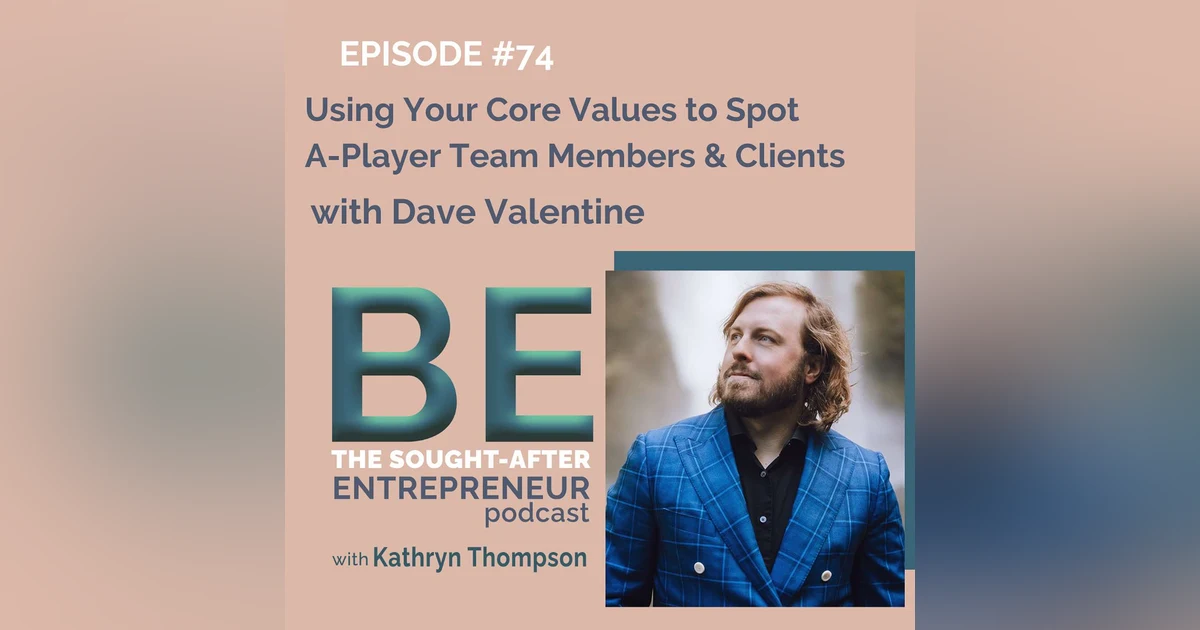


If you want to attract A-Player team members and clients, it all starts with getting clear on what you value. So if you’ve been attracting team members or clients that aren’t the right fit, you’ll want to tune in to this episode.
Dave Valentine will share how to establish core values to spot A-Player team members and clients.
Dave BH Valentine is the CEO of Avadel Agency, An SDR agency setting your B2B company up with booked meetings every week with your ideal clients and customers. A business coach, dad, and friend, Dave sets everyone up around him for success by creating a space where they can thrive.
BY THE TIME YOU FINISH LISTENING TO TODAY’S EPISODE, YOU’LL LEARN:
- Why you’re attracting team members that aren’t a good fit and how to change it.
- How to establish core values that make spotting A-Player members easy even if they don’t have traditional experience.
- How he hired ballet teachers as account managers and why it was the best hires he made.
If this episode inspires you in some way, leave us a review on Apple Podcasts and let us know your biggest takeaway– whether it’s created those aha moments or given you food for thought on how to achieve greater success.
And while you’re here, make sure to follow us on Instagram @creativelyowned for more daily inspiration on how to effortlessly attract the most aligned clients without having to spend hours marketing your business or chasing clients. Also, make sure to tag me in your stories @creativelyowned.
Selling the Invisible: Exactly how to articulate the value of your cosmic genius even if your message transcends the typical “10k months” & “Make 6-figures” types of promises.
Free on-demand training >>> https://www.creativelyowned.co/watchnow
To apply for Elevate, an experience for coaches & consultants wanting to craft & scale their offers that sell on autopilot using attraction marketing, click here!
To find out how to own your unique edge, amplify who you truly are (& get paid for it), take your business to cosmic proportions, and have fun doing it grab it here!!
https://www.creativelyowned.com/quiz
To connect with Dave:
Get your 3 free calls by emailing Dave– dave@davebhvalentine.com and mentioning this show.
Instagram: @realdval
Facebook: https://www.facebook.com/realdavevalentine
LinkedIn: https://www.linkedin.com/in/david-valentine-95564891/
Personal Website: davevalentine.co
Company Website: https://avadel.agency
Kathryn Thompson 00:02
Hey, hey, I am super stoked to have Dave on the show today. And without further ado, I'm just going to turn it over to you, Dave, to introduce yourself to our listeners and share a bit about you and what you do.
00:13
Yeah, so my name is Dave Valentine. I'm the owner and founder of a portfolio of companies called the RC G group. And yeah, we work with a whole host of companies, right now we own a piece or an entirety of eight different companies, cool. Most of them serve, you know, b2b service companies. So agencies, SAS products, that sort of thing. 20 To 500 employees is typically where we're at. And then we do have some outliers, though, I also own a flight school and SAS products. And so yeah, there's always something fun. We're looking to buy some European football clubs at the moment. So there's always something interesting and different going on. Oh, wow,
Kathryn Thompson 00:59
this is gonna be such a fun conversation. How did you get into owning these suites of companies?
01:06
Yeah, well, I, I, when I started my first company. Yeah, I it was a digital ad agency. And I knew from the beginning that I wanted to own multiple companies, multiple brands, I really have this belief. And some people don't love it, Katherine, but whatever, I really love it. And it's if you have the tenacity, if you have the drive, and you have the capability, then you have to go do that thing. And so for me, my real goal in everything that I do is to provide great workplaces for people and to pay them well. And so, you know, it's one of the things that gets me out of bed in the morning. And then the second thing that's really, really important to me is, small businesses are where it's at, like us can't convince me otherwise. And so a lot of my companies serve small businesses, or they literally like the flight school that I own, serves people that are like, hey, I want to do a nontraditional career that actually helps me have this really dynamic, beautiful life. That's really what I'm about. And so that's, that's why we kind of got into this.
Kathryn Thompson 02:14
So cool. And so the flight school you will pilot, or do you have your pilot's license, or
02:19
I'm working on it? Yeah, so I'm working on getting my pilot's license. But my brother flies for American Airlines, my dad flies for American Airlines, he was an Air Force pilot, my grandfather is or was an Air Force pilot flew for Delta Airlines, my father in law was a pilot in the Navy. So pilots are my brother in law's a pilot. So all these people around your pilots, my brother, and I had for a long time wanting to go in business together. And it was like, Man, this is a no brainer, he went through flight school itself, like he kind of knows how to get through the civilian route. So we kind of knew that this was a thing that could be lucrative. And then my my backgrounds in marketing, so I was like, Well, hey, you know how to do the flying, I can do the marketing and branding. Let's do this. And it's one of our fastest growing companies in 2022, which is really, really exciting.
Kathryn Thompson 03:06
So cool. And then the football. So like, how did how did that start? And what is your passion there?
03:15
So I grew up playing everybody, we call it soccer. I grew up playing soccer, right and, and, and I loved it. I loved everything about soccer from the game itself, the strategy behind it, there's, there's so much more strategy in that people know, because most people's experience of soccer is watching their little kids play, right. And it's just this clump and mass and and then as they get older, a lot of times those kids graduate into other sports now some of them obviously continue to play soccer. And they can start to see some tactical moves and some different things that are happening as the their kids get into high school. It doesn't really transpire though, until they get into college that tactics become a thing that are readily implied and taught to students. And so what that means is most people don't understand the nuances of the game unless they live somewhere else in the world. Right. And so I am a huge Manchester City Football Club fan. I have been since before they were good. They're quite good at this point. And so they have a lot of bandwagon fans and I have to like state No, like I really loved them before they had won a trophy. Because it's important. And, and so I really have seen what some of these, they're called football groups. They owned multiple football teams across the globe. An individual club itself is not very profitable, but a group of clubs every year is exceptionally profitable. And so there's all sorts of interesting things that go around this to me, Katherine about how you can build great businesses where you're literally taking young men and women because a lot of the clubs that we're looking at have men and women's teams. Yeah, and you're giving Have them an opportunity to go through an academy where they're going to get educated, they're also going to learn soccer skills, then when they turn 15, they can sign their first professional contract. And it's a non insignificant number. And then you can help them develop into going to a bigger club, having like a better experience, whatever that is, right? Whatever that is for them. Or maybe they just want to play at that club forever, because it's their hometown team. And so I just love this idea of sports and what it does for society, it allows us to be tribal in a non violent way, which I think is just an absolutely gorgeous expression of like, what it is to be human, you know? And so like, yeah, I get excited and jazzed about the idea of finding these things that most people overlook, as like, hey, that won't work, or that's really audacious, or, you know, everybody else does that. And I'm like, what if we did that differently? You know, and that's really the like, one, when everybody's going this way, I love to go the opposite way. And so most people look at a lot of the businesses that I own, and they're like, well, aren't there, like issues? Aren't there risks aren't there? And I'm like, oh, yeah, sure, of course. But that's why we do it like this, I think, oh, my gosh, that's brilliant. And that's why all of our companies grow really fast is that we're really just doing things quite differently than the micro marketplace.
Kathryn Thompson 06:12
Yeah, I lost, I grew up playing competitive soccer. So as soon as you said, like, for clubs, I was like, Oh, my God, I need to ask you more about this, because, and my husband's a Liverpool fan. And we're heading to actually Lisbon on Friday. And we're trying to get to a championship game in Lisbon on the 12th. So yes, I have a soccer and I love and I know how much it gave me in my life and why I'm so successful in what I do. And so I was just super curious about Yeah, what got you sparked into looking at even investing in teams. So you talk about, you know, when when companies go one way, you tend to go the other way? And I think that's a really great skill and asset to have as a business owner, and why people are successful, because we think of things differently. So what are some of the ways that you approach business differently? Like what how do you how do you think about things? Like, what is the risk of investing in a soccer club? Like if people said to you, you know, like, You're crazy. Why are you doing this?
07:14
Yeah, so the way that I so here's the great part, Catherine, I didn't always used to think differently. Okay, my first my first agency, I had been doing marketing work. And this is going to age me quite aggressively here. I was running Friendster and MySpace and building websites and web 1.0. You know, like, and that was my marketing back. And I was doing video editing before, a lot of people did video editing outside of like news stations and stuff like that. So it was like this really weird cutting edge space in the early 2000s. Right? And I had only ever worked in house. And so when I went to go work for this major pharmaceutical company, they said, Hey, can you be our point of contact for these marketing firms? And I was like, Sure, of course, yeah, I can totally talk to him. And we had like, four, it was a huge pharmaceutical company. And we had like, four of these agencies, and all of them were terrible, give us good numbers. They didn't weren't telling us the secret sauce. And so I started this, this agency out of like this, I could do this better. I'd never sold, you know, client business before, I'd never done any of that stuff. And so what I inherently did was I started copying the websites that I saw for other successful agencies that I admired. And a lot of the things that they did are things that I would call mistakes now. So in the agency world, and example, you know, a lot of people don't put their pricing on their website, I think that you should just be upfront about your pricing, a lot of people sell on scope of work, I think that that's a terrible way to go sell on results. So all my companies sell on actual things that are going to happen. That way, you don't have to worry like you're not selling a scope of work. So now I'm never having a conversation about hours. Yeah. And so what ends up happening is I can produce a really, really, really valuable service at $5,000 a month, and my team may spend five or six hours on it in a month, the client doesn't care. They never asked about how long we're working on it. As long as they're seeing results. They're ecstatic. And so that was really the switch for me, when it comes to the football clubs. What most people don't know. So there's 1000 professional football clubs in Europe, over the course of 2021 only 10 of them so 1% more profitable. Now you look at a three year snapshot, that number gets a little bit bigger, but it's not huge. It's still like five or 6% the thing that's really fascinating those that no one's looking at why those teams are very and I mean, very profitable, when it comes to how they do this. And the reason why they a lot of teams struggle for profitability, honestly Catherine because they have relegation, which is totally foreign to North American and sports at large. Obviously they have that in the Mexican football leagues, or soccer leagues, but they have relegation. So if you get relegated, you lose massive amounts of income from being relegated. So you almost have to redline it and be really close to net zero in order to have like a really quality product on the field. And what what my background has been with people, and when I've done some coaching, and when I've had these conversations, I really look at this as a gift that I have, hey, not what position they're playing now. What position could they play? What skill sets do they have? How can we really maximize the most as player this is what great coaches do in any sport, they look at what you're doing, and they say, You know what, actually, I know you've played defense your whole life, we're going to put you on the attacking side. In fact, we're going to put you on the opposite foot, we're going to put you on the left side attacking, I know you're right footed, and we're just going to try that out. And then you get these amazing results. And everyone's like, what happened? How did that how did that person turn it around, and it's merely putting the right person in the right position, the right seat and business to find the success that they need. And it's always finding those people really, that have the mentality. It's, that's where it's at. It's all up here. talent matters. And if you just have talent, you won't make it. If you have talent and drive, you can go anywhere. And so that's really the philosophy behind having these, these football clubs is building fantastic academies at each one that also allow for those players to progress be sold, because that's how they do it in Europe. And then recoup that and reinvest back into the academy, not necessarily back into the first team, but back into the academy to continue to push forward, young men and women who are just ready to excel and succeed.
Kathryn Thompson 12:06
So amazing, and you touched on something really important. And that's the whole talent piece. Like you can have all the talent in the world, whether you're a soccer player, or you're working in a business, or running a small business, you can have all the talent in the world. But if you don't have that drive that mindset, that intrinsic motivation to want to do, it won't matter because you'll like flee, eventually, either quit if something, you know if you hit an obstacle, or roadblock or whatever it is. And so, and you talked about your passion of building businesses, but more importantly, building really powerful teams, right, putting people in position. So and I know when before the podcast, we you know, one of the things was is you hire ballerina dancers over, maybe somebody else that might seem like a more fitting role person for the role. Is that the same sort of positions, like do quite a bit different than probably how other people would look at hiring or filling positions. Yeah,
13:14
I mean, basically one of the things that we have six core values, Catherine, we're actually going to be publishing a book about these six core values in the near future. It's a thing that I've been working on for a while, I think it's going to the book, we have a tentative release date for January. At editing is so fun, Katherine, it's Yeah. be reading the book on time. But, but one of the things that, that we really try and do is we hire, promote, and fire based off the core values. So there's six of them. And I really care more about the person and their mentality, rather than their experience. Right. So the ballet teacher, she, she we brought her into being account manager, she's never had client interactions before. She's crushing it. You know, like, she's objectively fantastic. We've hired my one of my favorite stories is we have a lot of teachers in America that don't want to teach anymore, because of laws that are being passed that I think are draconian, or because it's just a lot, the pandemic war, a lot of people out. We've hired a number of teachers, and they're like, oh, my gosh, this is the best job I've ever had. And they've been copywriters, right, we've hired people that were flight attendants for regional airlines that were making $21,000 a year and we bring them in to our bottom tier position, which makes 42 a year and they can't believe they're getting paid that much. And then they are massively successful in their role. And we've done this consistently and one of my favorite stories to tell Katherine because it's so juicy, it's so good. We hired a woman who was an admin assistant. For I believe the Psychology Department at a university. So she's not making any money at all, really. And so we bring her in as a copywriter, and she grows as a cop as a junior copywriter. And we put her into a senior copywriter role. And then we put her into a copy chief role. And then we move her into the head of strategy role. And now she's our chief product officer. So literally in three and a half years, she's gone from being a junior copywriter, she's had five promotions. Amazing. And so it's one of those things where if you find smart people who want to work hard, yeah, you know, and then you can do anything. And a lot of times, those are the people that are passed over, because they don't have experience. And it's like, actually, those are the ones who are fantastic. Those are the ones so one of my, you know, the things that I was having a conversation with some entrepreneurs recently, and they're talking about how they can't find anybody to hire that that has experience, that's any good. And I just asked like, Hey, what are you looking for? They're like, well, you know, I needed to, they need to have a degree, they need to have experiences, like, why I was like, you know, and I tell them stories, I'm like, This person doesn't have a degree if that person isn't having a degree, this person was a stay at home mom for the past 15 years doing like a multilevel marketing thing. She has no experience. And now we've brought her in and she's like a vital part of and then it blew their minds to hear that you could hire people and have success that don't have experience. And I think that that's really what it's about is believing in people and giving them an opportunity. And then if you give them an opportunity and train them well, they're going to succeed.
Kathryn Thompson 16:35
Yeah, and I love that is looking outside of the box, so to speak, and not overlooking because copywriting I'm a copywriter, so it can be specialized role, but I love that you can like it gives people hope that you can train people to be amazing copywriters, even if they don't have the experience, didn't go to school, don't even think they're a good writer, for that matter. Right. I was reading an article recently, Cole Schaefer, he is a copywriter as well. And that was one of the things he had asked a top CMO of billion dollar company was like, how were you so successful? And one of the things he said was, he hires people that are like not traditionally trained for the role, because the mindset, what are some of the key things you look at when it comes to mindset or drive? Like, what are you looking for in that person that might not have that experience, so to speak, so you don't overlook them?
17:31
Yeah, so So the core value, the six core values that we have. The first one is tenacity. And it's our most important core value. So these are literally in order some like so what our hiring manager will do is she will ask specific questions about the tenacity of a person and like how tenacious they can be. And she'll ask in a way that they don't necessarily know that they're being asked that question, the second core value is curiosity. You have to be a lifelong learner to to succeed in this game, you have to be right. The third one is initiative, if you see something broken, just because I'm the CEO doesn't mean that I need to go fix it, right? You know, and so the fourth one is accountability. It's like, Hey, listen, I want you to be accountable when you hit a home run, and you super succeed and be like, Yeah, I did that. And it also wants you to be accountable when things don't go as planned, because that's equally as valuable. The fifth one is transparency. Just tell us what's going on be who you are, you know, like, I'm going to tell I would, I'm an open book, Katherine, I would tell you anything, because I don't know what else to do. And then the last one is humanity. And humanity for us says like, hey, the whole idea that you're going to check your personal life at the door is crazy. And we have to have some semblance of understanding that this is a person having real life experiences in real time. And so we say that those are in order. What's really fun, and I'll share this with your audience because I think it'd be good for them. Yeah. So we look at that for all of our employees. And then when they move into a leadership role, we reverse them. So we say you have to lead with humanity, transparency and accountability, because the only way that you can get into leadership is if you have tenacity, curiosity, and initiative in spades. So then when we flip it and we say, Listen, you really have to lead with humanity. People are like, Oh my gosh, so then it's like a total flip of the mind of like, oh, yeah, if I support my people, if I love on them, if I put them in a good position to succeed, they're going to be excellent. If I lead with tenacity, purely as a leader, what I'll do is bring my people out so anyways, it's super fun to have these little things that we do to hire people.
Kathryn Thompson 19:47
Yeah, I love the core values and I love how I've never heard of it in that way flippin like of how to, you know, if you go in, like you said, get to leadership, and you're leading with tenacity and your go getter and ambitious and curious and all of that is like, how easy is that transition? When people get into leadership? Does it take a while? As someone who's super tenacious and a go getter?
20:14
Yeah, Catherine, it can for some people because it's not into, it's not how they got to where they are. Okay, you know, and that's, and that's what's fascinating, right. So like, I, the only reason that I figured this out the flip is because I messed it up, you know. So like, whenever my first agency grew, I kept leading with tenacity, curiosity, and initiative, and my team was just frazzled. And as I've worked to purchase new companies, and start up new companies, and I bring in more leaders to existing brands, I consistently find that if a leader leads with the first three and not the the ladder, three, they're going to struggle to keep a team to help them get where they need to go. And there's a subtlety to this too, right? You still need to have those three. It's just not how you lead your people. So you private. So a lot of things that we do that we talked about leadership, listen, you're going to still have tenacity, curiosity, and initiatives. And you're going to do that privately. And then every now and again, you're going to show it to your team. But like, we will say things like, Hey, don't update our project management software, after close of business. Don't update it on the weekends, wait until Monday morning, you can do it early. You know, you can get up as early as you want on Monday. That's cool. We don't want to burn our people out by viewing what leadership team members are doing and being like, Oh, I gotta I gotta meet that level. And it's like, no, we actually need you to meet your level, which your waterline and then we can see how you can move into leadership after that.
Kathryn Thompson 21:54
Yeah, such a fascinating, fascinating way to look at it. And I equally feel like I've you know, definitely have made those mistakes, leading teams as well. In terms of like being that go getter and, you know, checking things on weekends, or even responding is on week eight. And it's so interesting that our team will maybe not even know it, but they'll match us and what we're doing without us maybe even really realizing like, we're not putting that expectation on them. But they see us doing it, they're going oh, well, if I want to get into leadership role, I need to work weekends, I work evenings or, or whatnot. So such a powerful shift for people. So you mentioned that you're, when you're hiring people, and you're asking questions around tenacity, you do it in a subtle way. Can you share with us? What's how that subtle without just saying, Hey, are you tunap? Tenacious?
22:46
Yeah, it's a lot of times it's asking for stories, right? So tell me about a time you can solve a problem. What did you do? You know, tell? And so sometimes, in that, that question, will get tenacity, curiosity and initiative answered, you know, because they may just be like, well, I couldn't figure it out. And I got into the data, and I started looking at what was going on. And then I still couldn't figure it out. So I kept working at it. And I still couldn't figure it out. And I started experimenting with these things. And it still wasn't working is bothering me. It took me three weeks, but I finally got it done. Alright, so now we just saw tenacity, curiosity and initiative, because they were like, Hey, I'm not gonna give up. Hey, I'm trying to figure out what's going on here. I'm asking good questions, and then initiative of like, I'm just writing the thing, or I'm just producing the thing, or whatever that is. And I'm going to find the answer, because I'm taking initiative on the things that I'm finding based on my curiosity. And that's really the thing too, that works with this, Katherine is that if you're tenacious, you will inherently ask questions. If you ask questions, they will inherently lead you to action. And if there's a disconnect in any one of those steps, then obviously, there's something that like, is not going to align with us as a company. And so we've just found and here's what's really interesting, too, we found that people that don't fit the core values, like they're just in and out really fast, like we figure it out within a week or two, because it'll happen, right? Somebody will present excellently, and then they get into the workplace. And it's like, oh, no, that was a great show you put on like, good giant, I mean, that's like, good job on them. And also, like, this is going to be terrible for you if you stay here. And I mean that sincerely. I don't want people to be miserable at the place that they are working at. And everybody can go find another job. Like there's always another job. And so I never feel bad. I'm just like, look, you're going to graduate on to somebody else. It's not getting fired. It's graduation time, you know, so anyways, yeah.
Kathryn Thompson 24:55
I love that. And it's interesting that within a week, you know, or to you can gauge whether or not they're going to be a good fit. So do you graduate them on like, really quickly? Or do you find that you're, maybe within the first two weeks, you're kind of getting the signs, and then there's more of a leg time, because I know a lot of our listeners, I know a lot of our listeners likely have gone through the experience of like holding on to team members longer than probably they should have. And so it's like, where do you navigate that of like, it's time for you to move on some to somewhere else?
25:32
Yeah, I, here's what I noticed a long time ago was that I never, in my entire career have fired someone too quickly. It's never happened. It's I've never been like, oh, I fired that person, they went on to be massively successful. Within the next couple of years, it hasn't happened. What has happened, though, is we've let somebody stay around for three months too long. And it causes culture issues, and it causes client issues, and it causes customer issues. And so it's like we knew for three months, this person was a problem. And so it's one of those things where it's like, I started realize that a players a players are easy to spot, and they really reveal themselves within the first week or two, doesn't mean that they can't regress, doesn't mean that the a player newness doesn't mean refining. It just means that you understand this is a person that's going to show up, they're going to be engaged, they're going to all that stuff. So that's really what we look for. And then the other thing too, is Katherine, we have a really, really short hiring process. I want so so there's some fascinating data that came out, this is really good for your listeners, this showed that a players like the top, the top the top, they will get a job within eight days of looking. So if you're like, hey, I want and I used to have a long hiring process. So I know this, I want to do a first round interview, and it's going to be a phone interview for 15 minutes, then I want to do a second interview, and it's going to be an hour. And that'll be a week later with their you know, direct supervisor. And then a week after that, I'm going to take them to dinner. And I'm going to sit down with them with my wife and their significant other if they have one, and we're going to talk and I'm gonna see how they treat the waitstaff and I'm gonna see, you know, like, and I used to do that, and it would give me a beat on a person. And I miss out on really quality candidates, because they're like, Hey, I'm going, I want a job. And so instead shortening that timeframe to say, hey, we're going to do that first 15 minute meeting. And we're going to see if they have the core values, if they have the core values, can we get them into a meeting with, you know, someone on our team two days later? Because we should? And if they're really that great, then let's get them home? You know, and if they're not, then we'll find somebody else. But if they're really that great, we love them, let's just get them in the door.
Kathryn Thompson 27:55
Yeah, I love that you share that, because I've been in when I worked in corporate, you know, the process was so long, like you just mentioned, and there were times in between those periods where it's like I had secured another job somewhere else, before somebody else had gotten back to me. And I see this a lot in entrepreneurship, as you know, small businesses hiring people using sort of that same corporate model, where they're dragging out the best process to try to really get a sense of whether or not a person is the right fit. You mentioned the qualities of an A, it's really easy to spot a player, what are some of those qualities?
28:42
The A players really have all the core values. And that's really it. And it's not like a little bit, it's like very, very, very evident. Oh, man, they have all six core values, they are ready to rock, they're ready to go. And that's what tells us they've got what it takes. Sometimes they have extreme, you know, one of the things that we do is sometimes we'll hire someone that has experience, right? So it's not like we're always like no experience. It's just saying, hey, what do they have? Like one of the things that I've really realized Katherine is there, our the way that we do leadership, the way that we train our people, it's so unique. I'd rather have someone that's raw, or changing career paths, because they don't have any bad habits. Because they don't have anything that's like, Well, I'm here because I'm really my resume is great. I'm like, No, I want you to be here because you love your work. You really are pumped up about it, you see a trajectory for your future, which I want everyone to have. And you know that you're going to be trained, you know, that you're gonna be taken care of, you know, that we're going to give you meaningful raises. So like one of my favorite things to do is I'm like, Hey, listen, if I give you a raise of $3,000 in a year, it means that you're not doing a good job. It means that I'm that's my cost of living raise. Is 250 bucks a month for someone that I'm like, and that's a significant raise for a lot of people compared to other job places. You know, like, it's way more than most people get. I remember my first one of my first jobs, I got a 1% Raise. That's like, what I even do with a one. Like it was like $15 more on my paycheck or something like it was an absurdly small amount. So I love to give people like meaningful amounts, one of my favorite raises to give us like six grand, because it's 500 bucks a month, you know, and it's like, that's a felt difference. You know, that's a car payment. That's a Yeah, that's a meaningful increase. And so anyways, yeah, I think that that's really what we aim for is those eight players have those qualities, where it's like, it's just evident that they're oozing with all six core values. And we will get them where they need to go, because they're already hungry.
Kathryn Thompson 30:51
Yeah. And so just for clarification, for our listeners, it's like, it's the core values that you've established within your business that match those a player game. So your core values will look differently to somebody else's potentially. Yeah,
31:08
and I think that that's that, look, that's the thing that most people get wrong. They they do the core values, they do their mission statement, and they're the only ones that know it. They're the only people that are, you know, that are really pushing it forward, their team doesn't embody them, because they're not really regularly talked about, we run our business with EOS. And so what that means is the Entrepreneurial Operating System is what to us is. And so what that means is we do quarterly reviews, right? So every quarter, we're reviewing people based off the six core values, and they get a score based off that. So our whole thing is like, Hey, how can we continually put this in front of our people, and I usually bring them up in like stand ups once a week, hey, listen, I just want to highlight that Eli did this really great thing this week, he crushed it on curiosity, here's how he did it, you know, I want to highlight that Alicia really did a fantastic job of demonstrating humanity, whatever that is, because we want to keep it front and center. And so anyways, that's, that's really, when it comes to the core values, I don't just think that it's important to have them, I think it's important to embody them and to communicate them over and over and over again. And I will say, I've seen a lot of this is going to be totally self-aggrandizing in some ways, but whatever, obviously, a lot of core values. And a lot of them were terrible. A lot of them were like we believe in customer service. And, you know, it's all about teamwork. And it's like, no, that's not a core value. That's a platitude, that's, that's a feel good thing to say to a customer or client, it doesn't have a significant difference on your team, and how you work towards success for your customers and clients. And so I challenge people a lot, I tell people a lot I'm like, because I one of my businesses is consulting, I encourage my clients to adopt our core values, because I'm like, Look, they're good, I have a lot of stuff written about them, I have a lot of good help for it, for how to document these and implement them. And really, honestly, I haven't seen any six or any five that are better than what we have doesn't mean it couldn't exist. It's just hard to go find those.
Kathryn Thompson 33:12
Yeah. And like I said, the way in which you I mean, your core values are amazing. And the way in which you shared about like, even just the flipping, right? When you get into leadership and all of that it's something so unique that I haven't haven't heard before. You You're writing a book about these core values, and you're in sort of the editing process right now, when is that book slated to come out?
33:33
So it's supposed to come out in January? And yeah, we're really excited. It's the first book that I've ever written. I went back and forth on I've written the starts of several books, because yeah, that's kind of how I roll. And I talked with some friends of mine who have already published and kind of ran some ideas, paths, and they're like, you know, honestly, Dave, I think the core value thing is so unique, so different, it's really juicy, that I think that you should lead with this one, it should be your first book. So anyways, that's kind of, it'll be out in January. And I'm sure there'll be lots of press around that and whatnot. So it helps to have a PR firm that you own, so that they can kind of help you promote it.
Kathryn Thompson 34:16
Yeah, I love that. And I think yeah, you're absolutely right, that the way in which you talk about core values is just very different than anything I've ever heard. So I think that'll be amazing. When that book drops, our listeners can get their hands on it, because it's gonna Yeah, change people's businesses and who they hire and how they hire and all of that. So it's been such a pleasure chatting with you. Is there anything else you'd like to share with our listeners before we wrap up?
34:42
Yeah, Catherine, I would love to offer your listeners a giveaway if that's okay. Like anyone on it. Sweet. Yeah, awesome. So one of the companies that I own is called arbordale Aava de el and it is an outsourced SDR or BDR agency. So they are Should we book b2b meetings for clients? So if you're an agency owner, you're a freelancer, you always need more clients. This is one of the things that I had to figure out for myself. When I started my first agency, how do I get new clients and I used to kill myself networking, and then I sort of figured out like, hey, there's actually a much more sustainable way to fill your pipeline. Yeah. And so what I'd love to do for your listeners is give them three b2b meetings booked for free that they can try and close deals on and kind of move forward. So all they have to do to take advantage of that, Kathryn is they can just email me, David at arbordale Aava DL dot agency, and just mentioned the name of this podcast and the headline of the email and say, Hey, I'd like to take you up on the three free and then I'll get them connected with the team and they can get that rolling.
Kathryn Thompson 35:46
Brilliant, and we will link that up in the show notes so that it's just easy for them to shoot you over an email. Again, it's such a pleasure having you on and I can't wait for this episode to draw.
35:56
Thanks, Katherine has been a pure joy for me too. So I appreciate it.
36:00
Thank you