
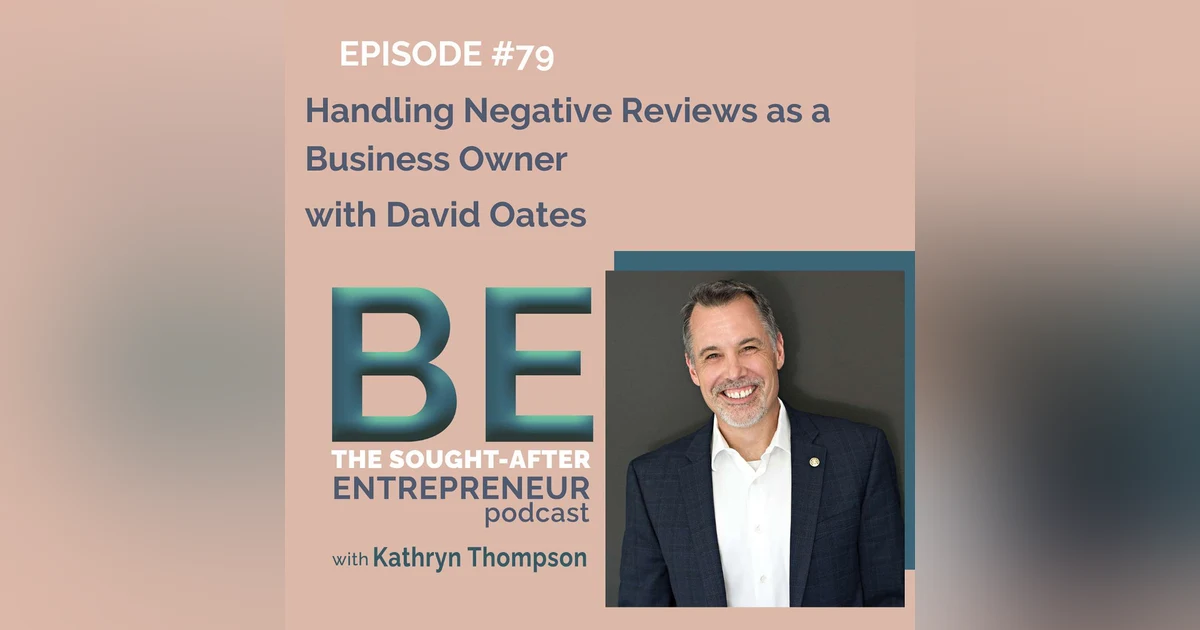
How to Handle Negative Reviews as a Business Owner with David Oates

 Apple Podcasts
 Overcast
 Castro
 PocketCasts
 RSS Feed
 Receiving negative reviews as a business owner is unavoidable, so why not learn how to navigate it with grace.
Listen as David Oates shares practical tips for how small business owners can handle negative reviews.
Dave possesses nearly 30 years of strategic PR experience dealing with a myriad of crises that span sports/entertainment, non-profit, military, government, corporate, education, charity, and start-up environments. He received his MBA from San Diego State University in 2004 and his bachelor’s degree from the University of Maryland in 1991.
BY THE TIME YOU FINISH LISTENING TO TODAY’S EPISODE, YOU’LL LEARN:
- How to keep your ear to the ground to know what’s being said about your business.
- Mistakes small business owners make when dealing with negative reviews and how to avoid them.
- Why getting ahead of negative reviews is critical to maintaining your reputation.
If this episode inspires you in some way, leave us a review on Apple Podcasts and let us know your biggest takeaway– whether it’s created those aha moments or given you food for thought on how to achieve greater success.
And while you’re here, make sure to follow us on Instagram @creativelyowned for more daily inspiration on how to effortlessly attract the most aligned clients without having to spend hours marketing your business or chasing clients. Also, make sure to tag me in your stories @creativelyowned.
Selling the Invisible: Exactly how to articulate the value of your cosmic genius even if your message transcends the typical “10k months” & “Make 6-figures” types of promises.
Free on-demand training >>> https://www.creativelyowned.co/watchnow
To find out how to own your unique edge, amplify who you truly are (& get paid for it), take your business to cosmic proportions, and have fun doing it grab it here!!
https://www.creativelyowned.com/quiz
To connect with David:
Welcome back, super stoked that you're tuning in to this week's episode. And I cannot wait to dive into today's topic because we're talking about something I know most business owners try to avoid, like the plague. And that is receiving negative feedback or criticism from clients or customers. And receiving that feedback on things like Google or Yelp, or Reddit or wherever else, they can leave that negative comment. Maybe it's on your Facebook business page, maybe it's on Instagram, wherever you're hanging out, and they've left this negative review. And you with anything wish you could just avoid it or wish it to go away. And I have a very special guest on that is going to talk about how to handle this. Because getting that negative review or comment is something you can't avoid. If you've been in business long enough, you know, that it's a bound to happen that somebody that comes in contact with your business isn't going to be satisfied for whatever reason. And it's not something that you can avoid. Therefore, you have to put things into place that can help you navigate this terrain, so that you can handle it in the best light possible. And I share a story of a local business where I live, who didn't handle it the best way. And there are many other examples. We share that in this episode. That is why I'm really excited to have David Oates on the show today because he possesses nearly 30 years of strategic pure experience dealing with a myriad of crisis that spends sports and entertainment, not-for-profit, military, government, corporate education, charity, startup environments, you name it. So I'm really excited to have this conversation with him because he shares very practical steps that you can take and put into your business don't have to be a big business to do this. They're very practical steps that you can apply now so that you can handle this criticism when it comes into your business and when people are talking about it so that you can get ahead of it instead of hiding behind it, which is the one thing you don't want to do. So without further ado, let's welcome David to the show.
Kathryn Thompson 00:02
Hey, hey, I am super stoked to have Dave on the show today we are going to be diving into how to turn a negative review into something beneficial for your business. So without further ado, I'm just gonna turn it over to you, Dave. So you can let our listeners know who you are and what you do.
00:19
Thank you, Catherine. Thanks for having me on. Yeah, Dave Oates, I'm a PR consultant, specifically, I do crisis communications. So anything related to helping an organization when their reputation is being called into question on things like the press, and blogs, social media accounts, and in particular online reviews, because that's where a lot of organizations, big and small mom, and pops to larger organizations get hit on a daily basis from somebody who, for whatever reason, maybe just their nose got out of joint decides to take it out on, you know, Google or the Facebook review platforms. It's nice to be here.
Kathryn Thompson 00:57
Yes, totally. And I love that we're going to talk about this because I know when I opened my brick-and-mortar, I've now sold it. But when I opened it, it was one of the things I tried to avoid, right is that like negative Google review. And if you're in business for any length of time, at some point, you're gonna get a review, or somebody isn't maybe happy with the service. And I think a lot of business owners try to avoid it just like I did, right. And then when that review comes in, they're like, oh, gosh, like this is going to completely destroy my business. So I love that you do crisis PR, and it's, it's really helping people, like benefit, potentially, from the negative reviews, but also know that they that they're gonna happen.
01:41
You brought up an excellent point, having a negative review about you on a site like Yelp, or even in GE, like, let's think about it from an employee's perspective, indeed, or Glassdoor, things like that. It's bound to happen. Because if you look at the statistics, the majority of people like something around 70% of those who write reviews write a negative review, because that's when they're incentivized, for whatever reason, they have a perception that their expectations were not met, and maybe their expectations were unrealistic. Or maybe like in the case of an employee, you had to let somebody go because they weren't meeting the standards, and they'll decide to take out their anger, you know, in some sort of online platform. So let's, let's dispel the myth that you can avoid a negative review. So what I'm hoping we can talk about today is how to respond when those negative reviews come out there, but also how you can actually get your loyal customers and patrons to write a positive review in a manner that still conforms with the terms and conditions of the review platforms.
Kathryn Thompson 02:45
Yeah, I love that. I love that. So how do you then go about incentivizing? Because you touched on something really potent there that most people aren't in sent device to leave a review, unless they're upset or frustrated, where they just want to voice that they didn't meet the expectations? So how then do you get your loyal customers to leave reviews on things like Google, Yelp, indeed, if its employees, that sort of thing?
03:13
Yeah, the first thing you should do is sort of an old tried and true method of engaging with your customers ask them afterwards how their experience was. Now I know, this is where a lot of mom-and-pop and a lot of small business owners go, I don't have the bandwidth for that. You can get platforms, there's plenty of them out there that you can put in to your customer database. If you've got one like an email program, or anything like that, you can import all of your the email addresses of your customers, and the most recent ones that came in, like, let's say you're a plumber, and you had five appointments in the day there and you got email addresses for those people. The next day, you can have a system that sends them an email and basically ask them internally, How was the experience and it's a quick sort of one to five star rating that a client has. And if they click a four to five, the system says, Hey, I really appreciate the feedback. Thanks for sharing that with us. Look, if you're so inclined, we'd love for you to share that on these platforms. You're not telling them what to write, you're not incentivizing them with any sort of special gifts or discounts for the next appointment, which is all conforming with the terms and conditions, but getting their feedback and hearing from positive customers, customers who like you, and then giving them a quick way to click on a button and go write a review. A lot of them will do that. And over time, you're going to see these positive reviews pop up on all of these sites. And so when you do get that one off negative review for whatever reason, at least people who are on the site can put that in the context and oh by the way, these review platforms will alert you if somebody let's say in that internal Hey, tell us I use tell us how your experience was puts a two or three star on there. Yeah, before they decide to take out their disappointment online. You now get an alert and have an opportunity to reach out to them one on one and say, Hey, we just got your feedback. I'm really sorry, we didn't meet your experience. What can we do to, you know, what can we do to make it better? How can I make this right? And that's really what a lot of customers want, when they're writing negative reviews, because they feel disenfranchised, they feel voiceless, they feel like for some reason, they are not empowered to make things right. So you get that Intel beforehand, because they didn't tell you in person because nobody likes confrontation, now you get an opportunity to fix that, before somebody takes it on online. So not only do you get to incentivize your happy customers to repositories, but you get alerted to potentially, to potential problems with customers that may result in a negative review before it becomes a crisis. So I'd say look at those free type of platforms that I'm sorry, some are free, and some are premium, I prefer the premium ones, they're not the best, they're a couple 100 bucks a month, they're not that expensive. And I would say it's well worth the investment or something like that.
Kathryn Thompson 06:00
Yeah, because nowadays to like everybody's looking for that word of mouth, right, or social proof. They're looking at reviews, whether you're booking a hotel room, or an Airbnb or whatever, or trying to find a restaurant to go to, you often look at the reviews that have been written about the place, right? So the $100 that you're spending, to gather that and to incentivize people to then go and leave that is only going to help you on the back end may attract more customers into your business. But you touched on something really important as well, which is the whole Terms and Conditions thing, right? It's like, because lots of people ask, or I've seen lots of businesses do this, right? It's like, leave a review or whatnot. And you'll get like a $5 gift card. So you talked about something about the terms and conditions. So why don't we want to incentivize people with a gift card or a discount or whatnot.
06:56
Because if the online review platforms find that you're incentivizing your customers in some sort of monetary fashion, either through, you know, a discount for the next visit, or they get a $5 gift card or something like that, they will look at those reviews as not being authentic, not being genuine, you have padded this if you will, and they'll simply discount, they will simply take those reviews off or filter them or someplace that's not being seen, and it won't count to your overall rating. If it gets to be so pervasive, don't kick you out of the Yelp review platform, which some people are like, well, I don't, I don't pay attention to Yelp anyway. You may not but your customers do, even if they're not writing reviews, they're gonna look at some third party validation, to say, is what I believe this organization to be what others say. So you being off of Yelp, and being absent of that, is just as bad as having a bunch of negative reviews without any positive reviews. So so you'll get kicked out from that, or they'll certainly the reviews that you do incentivize will simply be filtered, and they'll be worthless. So you don't definitely want to do that. You don't want to tell them also what to say. You know, even though they give you positive feedback, you can point them in the direction of you said, but you can't do much more than that. And I would, because you don't want to necessarily dissuade the authenticity from that. Because now your reputation is even further in crisis. Because people think you're not legitimate.
Kathryn Thompson 08:20
Yeah. And that's so true. Right is like, again, that. And you can see right through that right. When things are scripted. If you're telling people exactly what to say and how to say it, obviously, the authenticity is going to come out, because a lot of the reviews are going to look pretty much identical. So So yeah, and you talked about, you know, hit like sort of curbing the negative reviews or getting ahead of them, which I think is really important in crisis communication, right, or crisis PR is like to get ahead of the negative stuff that's gonna come out in light of whatever it is. And I think that was is such a key takeaway. And I want our listeners to take this away as like when you set up processes in your business to collect data feedback information, before it ever goes live on Google or Yelp, or Glassdoor or whatever. Right, is that you're asking them for their input, whether it's negative or positive, which, like you said, is ultimately what people want is just to be heard, especially when they have a negative, you know, review or or a negative experience with your business. And if you can do that offline, like not have it go straight up online, then then you can try to rectify that. So how do you respond to negative reviews? Whether it be offline, let's start with the offline first because I want to do the online one separately, like how would you respond to somebody emailing you privately?
09:51
Yeah, great question. So there's a couple of things first off, I don't care the size of the business, you have to have a mechanism in place to communicate with customers. I got a matter right now. out with here in Southern California with what I'll just call a youth sports activity private school, they do different lesson plans for youth over the course of the week, very popular, but they have been old school for a while that all they have phone numbers, they have now a matter where there's allegations that one of the instructors essentially was acting unprofessional. And it's causing a Big Rip within their client base that they can see the problem is, they really don't have a mechanism by which to one on one reach out to those customers and contact them. So they're defaulting to robo calls. So I would say first and foremost, before we get into the conversation have a system in place. Yeah, and there are very inexpensive ones there, where you're capturing at least email and phone numbers. And you can have a very quick way to respond to a lot of customers one on one, so they feel like they're connected. So now to your point, if you get an inbound email, from let's say, customer voice in the displeasure, you should not wait a day to respond, there should be an alert that comes to you, or somebody should be monitoring at least even on the weekends, if you're, you know, Monday through Friday shop, even on the weekends, like you know, once or twice a day. And if you get an email that says something is, you know, somebody's not happy about that, you should be prepared to respond that day. And when you respond, this is equally as important, you should be able to respond in a very personal way. And sometimes picking up the phone is still the best way to do so. And reach out to those individuals with empathy and action. And this is why I think it's important, but to cardinals, I don't care if it's a big fortune 500 company dealing with client matter, or you know, the local coffee shop. If you do not show empathy and action that you hear the customer, you understand they're upset, and you want to work with them to figure out how to rectify that, nothing else you said, will matter. And I'm not laughing. But they don't mean that you have to admit any wrongdoing, if there's no wrong or maybe it's just simply a misunderstanding. But if you don't get to the point where they feel like you're listening to them, nothing else is gonna matter. You're gonna fall on deaf ears, and certainly gonna fall on deaf ears don't respond to them. Or if you respond to them with sort of this point counterpoint debate, well, you missed this, you missed that you didn't see this, you missed, you know, I can't believe that we told you this time and time again, look, you might be right, still not going to defuse the situation. And that person is going to be so ticked off that they will write that negative review. So have a system in place where you're ready to respond within the same business day, if not, within a few hours. Don't wait a day, don't wait two days. It's not conducive. People will feel like you don't care, the longer you wait. So that's, that's the first and foremost, and then again with empathy and action. And that's where the offline.
Kathryn Thompson 12:48
Yeah. And I think that's again, you know, it, we've seen this with big companies, right, where silence was the thing that ultimately made things way worse in the public. I'm trying to think of one off the top of my head because there has been examples. I mean, I think,
13:04
yeah, I'll give you one. It's not necessarily in the online review. It's not a small business. But there was one that I did a video blog on, gosh, maybe a couple of months ago, Ulta Beauty, you know, that chain that came there, they had put out a email campaign that was in homage to a very well known fashion designer. Yeah, who had lost her life, not that much not that long ago to mental illness. And they had put out this, this email campaign. And I won't, I won't reiterate the words because they were really they were really offensive. They didn't mean it to be, but it basically gave and gave some sort intimated ation that people were going to hang out with this woman, at least, at least virtually Well, the use of that word, combined with the cause of the death, created a backlash. The problem was, this is a national chain. They sent out this email campaign on a Sunday. It took them until Monday at about noon, to issue a public response to customers to their email database online and to the press. That was 24 hours too late. They looked tone deaf and very insensitive for that 24 hour period. So that's a very visible example. But I would say, Look, if you're a small coffee shop, and somebody's ticked off at you for 24 hours, you got a whole lot of people that normally come in for that morning coffee for that morning, Dana's for whatever. And they're regulars, right? Well, maybe some of them don't come in because they're waiting for you to respond. What do you have to say about this? I'm confused now. This is might not be the coffee shop that I knew and respected. And all of that still plays well, for the small to midsize businesses.
Kathryn Thompson 14:44
Yeah, totally. I think Lululemon popped into my head because they want to see through pants right. And the owner was basically like, well, we don't make pants for bigger people. And it was like,
14:57
I remember that. Yeah. So you can you can get ahead
Kathryn Thompson 14:59
of it. but you can also then say the wrong thing in response as well. Right? So let's talk about speaking to the public, right? If someone leaves a negative review on Google about your coffee shop or whatever, and we had a local company or a business here, small business, they did plants, and they had a bit of a pizza shop inside their plant shop. And somebody left a negative review about this experience that they had at their place. And they came out and basically was like, criticize the person, you never expressed this while you were here, blah, blah, blah. And the response actually triggered a ton of negative responses. And it actually ended up being a case study in our business, local business school hear of like, what not to do when somebody gives you a negative review. So how do you respond to it? How do you respond to a negative review? That's online? That's public? That's for everybody to see.
15:51
It's a classic case, right? And I say it's because the business owner feels that their reputation was unfairly called into question, write their integrity, and by extension, their personal identity. So I get the sort of vitriol anger, point counterpoint argument that they post online, I go back to the same thing that we talked about for the offline comments, you have to respond online. And then really any format in a crisis and a reputation issue with empathy and action. So let's take the example that you somebody posts a negative review, in Yelp, you should respond that same day, which means don't be the last person, though, that somebody posted on there, those platforms that I mentioned, those, those customer review platforms that also help you build up your online review ratings, they a lot of them will offer opportunities to be alerted when a new review pops up, regardless of whether it was through their platform or not. So you're not the last person to know. And when that happens, the first thing you should say to that reviewer, regardless of what they say is, we appreciate that you took the time to voice your opinions, to voice your comments, we take all of those seriously, we're sorry, your experience wasn't to the level you were expecting. We want to make that right. A couple of things that we want to clarify. But if you will reach out to us, we want to make sure that we can see if we can come to some sort of resolution that meets your needs. So you can again state an opinion or state of state of clarification. Yeah, but but you need to do it in a way that you want to work with them. Regardless, sort of the adage of the customer's always right. And start with you heard that we appreciate you took the time, whether you are or not, is somewhat irrelevant. It is about making sure that they're being heard. And look, let's let's ask let me clarify or let me let me emphasize, I guess, the point in doing so your point is not to convince this reviewer to change the review. Haters are gonna hate this person is ticked off, they're likely to remain ticked off. There's not a lot you can do about it. But what you do is you telegraph to everybody else who goes on that page to validate whether they want to do business with you, that you understood, you took it for action, and you are caring about what people think. And that is as important as anything else. I got another example if we got time on what to do. If you think it's a it's a fake review. Yeah. Yeah, I get this. So like, this person's a rival, their client, their their competitor, something like that they're just peppering from that easy answer for that one got to start with the empathy again. So sort of, hey, we appreciate the comments. We take these all seriously, we really want to work with you. And then you follow up with, by the way, we can't find you as a customer, would you call us at this number so we can correlate the one there and see what we can do about fixing the situation? Again, you're not expecting that person to call, particularly if it really is a fake review. You're telegraphing to everybody else on that page that might not want to take this review at face value, because it's likely bogus. And even if it's not bogus, you're willing to work, you know, you're willing to work with them regardless. But at least in your mind, you're saying that they're but to say you're not even thinking about it, blah, blah, blah, you know, again, the argumentative anger is just as bad as not saying anything. All you're going to do is elevate the anxiety, elevate the anger, extend the crisis, damage your reputation, sometimes permanently, never get that revenue back. Never get back to normal operations. That's the worst case scenario by responding, as you said, in a typical fashion, which is angry or not at all.
Kathryn Thompson 19:25
Yeah. And it's so funny, because when we owned our brick and mortar we had I know for sure two reviews that came in that were negative one was a competitor. And what was interesting is I don't think he realized that his name came up like I knew who the owner of the other business was, and his full name came up and I did exactly what you said. So I got it, right. It was like, Hey, sorry about this, but I don't see you in our database. I would love to like, you know, fix this for you or whatever. And obviously no response there, but it was his full name and it was like, I know exactly who you are. And I think probably ever, I mean, we were local. And what we did was quite specialized. And there was only other six other stores locally that did what we did. So other people knew who the the owner was, as well. So it's super interesting. And that's why I was gonna ask you about the fake fake comments, because I think those happen, and how to how to deal with those. So you answer that perfectly. So I know we've covered a lot, and I and I hope that the listeners are taking away that we can't avoid the negative reviews and that sort of thing. But we can get ahead of them, or at least create an environment that people feel heard, regardless of what that is, is there anything else that you'd love to share that we might not have covered?
20:45
Don't be the last person to know when somebody's talking about you. And I would take this in broader context. And just simply on round reviews, there are free tools that any business can and quite frankly, should use to be sure that they see somebody starting to chatter about them online, before it becomes a crisis, because that's really to the point, I guess I would leave you with most small business think, well, we're not big enough to be, you know, have a crisis PR matter. Because you know, the local news isn't going to care about us, you know, the papers not going to write about us. And that may be true. That's not where the crises is nowadays, when everybody was carrying around these wonderful little mobile devices, with all these wonderful social media apps, who has a microphone, a camera and a distribution system, because of all their accounts can take you down in a nanosecond. So have systems in place like Google Alerts, which is free, and that you will get alerted. If somebody posts something about you good or bad. It have those online review platforms in place. So you get alerted if somebody writes a new review, have a system to check in, again, free tools to use if somebody's talking about you on Twitter. If you do that, you can then be ready to respond. And again, I don't care if it's an online review, or a social media posts or a blog, or if you've got to respond to press lead with empathy, and action to talk about how you hear them. And here's what you're going to do to kind of correct the situation, even if the correction is just simply a miscommunication. And you'll be fine. Don't be the last person to know somebody is talking about you.
Kathryn Thompson 22:20
Yeah, and I'm gonna leave it on that note. And I think the Google Alert thing is brilliant, too. Because I think there's, you know, there's even like things like Reddit or online forums, that it's not just on a Google review, or a Yelp review, right? It could be someone just having a side conversation or asking a question, and then it spiraling or on Twitter, right, people tweeting, right? It can be on all these platforms, it doesn't necessarily have to be a review platform that people are talking about you good or bad.
22:47
100% 100%
Kathryn Thompson 22:49
Yes, awesome. Well, it's been such a pleasure having you on and I know, our listeners are gonna love this, because this has been a common topic of conversation lately in my network of like, just really trying to avoid negative reviews. And I'm like, You can't do it, it's not gonna happen. Yeah, it's just not gonna happen. And the longer you're in business, you're just gonna get more of them. So it's just a matter of how to how to get ahead of them. So where can people find you if they want to connect with you?
23:15
Easy and appreciate you asking? My website is public relations, that's plural public relations. security.com public relations security.com. But if you simply Google Dave Oates crisis, PR, my LinkedIn account pops up Twitter, all of the other places that I met, and that I have, and that I engage folks in conversation. And seriously, if I hope, I hope your listeners will just take advantage of just connecting with me if they've got a quick question. I love what I do one small business owner to another, I'm happy to engage in a quick, you know, quick diatribe back online, it would be my pleasure. And I just wish everybody all the best.
Kathryn Thompson 23:55
Brilliant. And we will add all of those links in the show notes so that they're just easy accessible for our listeners to be able to connect with you. And I appreciate you inviting them to connect with you online. Because like you said, it's not just big business, or big companies that need this. It's also small business as well. Whether it be a mom and pop local shop, or an online business or whatever. So please reach out to Dave, if you have any questions about this because it is so important that respond in a way to create more reputation damage. Yeah, it's really brilliant. Well, it's been a pleasure and I cannot wait for this episode to drop.
I absolutely love the practical tips that David shared about how to keep your ear to the ground about what is being said about you out there in the public. Because that really is the key to navigating any criticism or defusing any criticism that's going on on Reddit or Yelp, or Google reviews, or whatever it might be. And this isn't just about large businesses, it's also small businesses as well. And when we can get ahead of the criticism, we can defuse it. And as David said, you know, when people have a negative comment or review, it really is just about them paying for something that they don't feel like the expectation met, what they paid for, and all they really want is to be heard and understood. So that is the essence that you want to go into sort of any conflict resolution type of stuff with customers or clients that are leaving those comments is how can I defuse this? How can I give them a platform to share with me and to feel seen and heard ultimately, so if you want to follow David, you can absolutely do that. We're going to link up his stuff around the show notes. Now on to our next episode. I'm super stoked about this. I have my first duel on Tim Swindoll and Scott Brown, and they're going to share with you how to use online trends to create hit products. They are the inventors of paddle Smash, I want you to think pickleball meet Spikeball. If you don't know what either one of those are, I think you're kind of living under a rock but that is all good. Honestly. Pickleball is the fastest growing sport out there. It's so fun if you haven't tried it, and I cannot wait to have these guys on because there's so much freakin fun so please be sure to subscribe to the show so you don't miss when this episode drops next week. Cheers


