
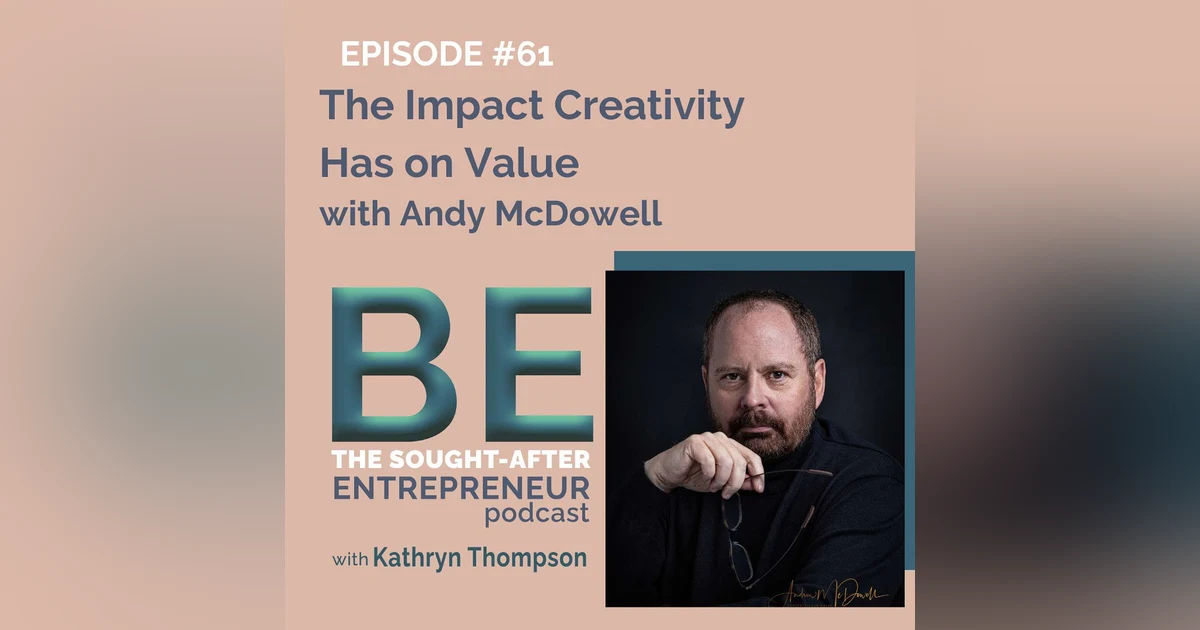
The Impact Creativity Has on Value with Andy McDowell

 Apple Podcasts
 Overcast
 Castro
 PocketCasts
 RSS Feed
 If you’re looking to stand out in your market and deliver exceptional value, this episode is for you.
Listen as Andy McDowell shares the key ingredient that impacts value.
Andy is an engineer by trade and a creative by nature. He spent 22 years with the Boeing Company, where he always felt more like a life coach than a boss. In 2002, he began his journey into entrepreneurship within a Corporation when he was asked to develop an Airspace Design Consulting business from scratch that would serve the global government market.
Naturally, his aviation work took him around the world and enabled him to work on high-profile projects - such as preparing the Beijing and Sochi Airports for their respective Olympic Games.
BY THE TIME YOU FINISH LISTENING TO TODAY’S EPISODE, YOU’LL LEARN:
- How creativity impacts value and how to integrate it into your business for optimal success.
- How to cultivate a culture within your business to empower your team to be creative.
- The key ingredient to standing out in the market and how to leverage that to impact others.
If this episode inspires you in some way, leave us a review on Apple Podcasts and let us know your biggest takeaway– whether it’s created those aha moments or given you food for thought on how to achieve greater success.
And while you’re here, make sure to follow us on Instagram @creativelyowned for more daily inspiration on how to effortlessly attract the most aligned clients without having to spend hours marketing your business or chasing clients. Also, make sure to tag me in your stories @creativelyowned.
Selling the Invisible: Exactly how to articulate the value of your cosmic genius even if your message transcends the typical “10k months” & “Make 6-figures” types of promises.
Free on-demand training >>> https://www.creativelyowned.co/watchnow
To apply for Elevate, an experience for coaches & consultants wanting to craft & scale their offers that sell on autopilot using attraction marketing, click here!
To find out how to own your unique edge, amplify who you truly are (& get paid for it), take your business to cosmic proportions, and have fun doing it grab it here!!
https://www.creativelyowned.com/quiz
To connect with Andy:
www.generateyourvalue.com
Facebook: /genyourvalue
Instagram: @generateyourvaluellc, @airspacedude
LinkedIn: /generate-your-value-llc/
Kathryn Thompson 00:02
Hey, hey, I am super stoked to have Andy On the show today. I'm just gonna turn it right over to you, Andy so you can share with our listeners who you are and what you do before I do. I'm just really excited to have this conversation all around creativity and the impact that it has on value. I know our listeners are gonna get a ton of value out of this episode, no pun intended. But yeah, without further ado, I just want to turn it over to you so you can share with our listeners Yeah, who you are, what you do and who you serve.
00:31
Well, first of all, thank you so much for the invite to come on the show. Looking forward to our conversation today. I am a while I described myself as a wife slash leadership slash small business coach in the Atlanta, Georgia area, Atlanta be in the southeast part of the United States for those that aren't familiar. But prior to that I spent a career in different facets of entrepreneurship. You know, so I started working for entrepreneurs, worked for two companies that were 50 or less employees. What was the technology field, the other was in the aviation field. And then second one got bought out by this big company and used to be headquartered in Seattle, Washington that makes airplanes that people fly in. It's called Boeing, which I worked my way up the food chain, so to speak on a leadership scale up to a low level executive, where I had to create a business from scratch, a consulting practice for governments, involving aerospace, design, as well as simulation and modeling. primary purpose was to bring in GPS into flight and ground operations. At the time, we had our little Garmin devices on the dashboards of our cars, but really hadn't been fully incorporated into operations for aviation. And Boeing knew that was gonna be a big hit and wanted an actual arm of the company to go out and help governments implement it faster on the government side.
Kathryn Thompson 02:05
So cool. So cool. And so I know our listeners are probably going to think like, okay, so what is your trade or your background, in being able to design these, this equipment?
02:19
Well, all it was on the job training. So my, my educational backgrounds in electrical engineering, as well as computer information systems. But I was one of those guys as a young teenager that was building the model airplanes and painting them and creating sets and cool scenarios with airplanes. I was had a fascination with aviation in the second small entrepreneurial company that I worked for, had to deal with aspects of aviation, because they were helping the cellular industry, which was just starting to grow to put up towers everywhere and keep them out of the way of airplanes. So we were on the ancillary side of aviation, but I saw a chance to go into something I had a strong passion for it to it, you know, something that get me out of the bed every morning with a smile on my face and go into work.
Kathryn Thompson 03:12
Yeah, well, I'm familiar with the mobility side of things. My husband is an electrical engineer and works for our local mobility company here wireless. So I'm familiar in that. I know what he does, but I don't really know what he does behind the scenes. It's like, over my head. So how did you transition out of working from Boeing into what you're doing now?
03:36
Well, one of my favorite things to do within Boeing was to mentor other people. I had a fabulous experience with an executive coach for myself, that Boeing offered about halfway through my career, it was such a great experience that I wanted to turn around and do it for others, because of the great experience I had and the changes in my leadership style and so forth that occurred. So I made it a point of growing that mentoring muscle within myself from that perspective, and had people sought after me as a as a mentor within the company because of the reputation I had built in. In doing it. I couldn't do a lot of people with I was traveling around the world half of the year, helping the government. So like I said before, and so I was limited to how much time it was in the office. It could do that for others, but I knew when I retired, my goal was to retire from Boeing after 30 years only me to 22 before the 737 max crisis sort of shut off 1000s of people's Boeing. And so I decided, well, I'm just gonna do it full time now set a part-time. This was my original plan if I had made it to 30 years of going, yeah,
Kathryn Thompson 04:55
so cool. So and I know that we're going to chat here about the creativity side of things and how it impacts value. So I'd love to know your sort of perspective on that and your thought process around like why you believe creativity has such an impact on value?
05:12
Well, I'm a firm believer that creativity is the engine with which value gets created. Listened to an episode you did about storytelling, and uniqueness of everybody's individual story. And that's what you're bringing to the table. And in the business world, we're looking for that uniqueness. That's why we have things like patents and so forth around to help protect that creativity that somebody had to create a unique idea and for a period of time, which differs in every country around the world, but you're going to have your idea protected, and reap all the benefits of that because of the creativity that you have. For me, creativity exists within everybody. And it's a muscle, you know, so you go to the gym, to workout your muscles to have a healthy life and be able to do a number of things in your life in the same way. Your creativity needs to be exercised in order for its true impact, knowing your own life, but the impact of others can allow that value to show up within the world. And value that gets created or extracted. Okay, yeah, are generated, right. So my creativity is going to generate some value in the world that somebody is thinking to extract that value into their own lives for the benefit of the value that that idea brings problem-solving or something of that nature. So that's the way I always look at creativity is it's the engine behind the value creation in it's a muscle that you need to exercise.
Kathryn Thompson 06:56
Amazing. So how do you go about exercising that muscle to develop that creativity for ultimate impact or the most impact? Well, it's
07:06
first going to start with mindset. So, five, six years ago, I picked up a guitar. I've been a singer all my life when I wanted to expand my musical capabilities. And I made a promise to myself, if I want to go spend 234, or $500 on a guitar and start playing it, I'm going to touch it for 1015 minutes every day. And I know, the first day that I pick it up is going to sound awful, absolutely awful. I'm not going to be Eddie Van Halen, or Steve I, in a job ponemos are all the big, you know, guitars that are out there, put work into it. And it was a journey for them just like it's going to be a journey for me. So if I don't have the patience, if I don't, if I have shame and judgment in my life, where I'm going to judge myself, because it sounded terrible on the first day that I picked up the guitar and actually started playing it, I'm not going to get too far, I'm not going to be exercising that musical muscle creativity muscle, so to speak in my life very much. So a lot of it starts with mindset to say it's a journey. It's something I want for myself. It's a discovery, I may think a guitar brings a lot of happiness to my life, but I may get a month into it and go, Ah, it's not all cracked up to be what I thought it was. And I needed to put the guitar down and go find something else to experiment with to see if that might bring joy and happiness to my life. If you can approach it from those perspectives, then you stay in a much better chance of longevity, with your creativity in your life.
Kathryn Thompson 08:55
Yeah. And so do you feel like entrepreneurs? Put the guitar down? I'm using the analogy because I think it's such a great analogy. Do you think that they put the guitar down way too soon? And they don't, yes, give themselves an opportunity to really flex that muscle? I
09:10
think it's just it's human nature. Yeah, we want and particularly in this day and age, so to speak, where we want instant gratification. It's like, if I'm not Eddie Van Halen within a week, then nobody's going to pay attention to me, so forth and so on. So is it about you want people to pay attention to you? Or is it about an inner joy and happiness, you're going to have by an ability to play guitar and the joy that brings to your own heart and if others get joy out of it, that's the cherry on top of the cake or cupcakes so to speak. It's more about I think this is going to bring joy and happiness to my own heart. And I'm going to go on that journey and do it from my own soul so to speak, as opposed to you know if You're a teenager, I want all the teenage girls to be paying attention when you because I picked up the guitar.
Kathryn Thompson 10:04
Yeah. So amazing. And I know this is a lot of the things that my listeners and my clients struggle with, right? Is that battle between the instant gratification that expectation that okay, if I put something out there, it should work within five days, 10 days a month. And if it doesn't, we're jumping on to the next thing to try and pick that thing up and to and to learn it. So how does one overcome? Wanting that instant gratification or that validation?
10:35
Oh comes from introspection? Do you have some kind of traumas in your life that need to be healed? What you're looking for? validation from outside yourself as opposed to inside yourself? Yeah, do that you're giving the power to everybody else, not to yourself. So what do you need to do? To have as a healing process to a say you want that for yourself? Be to take the time for introspection and figuring out where my fears in my life and fears exist up in our mind. And three, what am I going to do to eliminate those fears? Am I going to read books? Am I going to go see a therapist? Am I going to go talk to a friend is all kinds of different ways that go about and in healing those traumas, but you have to reach a point where you do the inner work first. Yeah.
Kathryn Thompson 11:43
Do you feel like people pick the guitar up? for the wrong reasons? So they're picking up the thing that they're doing? And they're, they're not connected to the, like you mentioned, you know, you've got to do it for your own joy and self satisfaction first before? And then the cherry on top? Is the people being like, oh, man, that's awesome. Or you can really help me or there's value here for me? Do you feel like people pick up something or they're doing things within their life that they're actually really not passionate about? Do you feel like there's a disconnect there? And that's why people are so quick to jump around as well.
12:16
Yes. And also believe, then you get a disconnect from your creativity. Ah, your uniqueness, your reason reasons you were created on this earth, the reasons why you're here, the reasons that you're living, your purpose in life, that that muse, that creativity that's inside yourself, is not going to come out. If you're, if you're always outward looking, you're gonna say, Well, what would Sally do? What would George do? My creativity, I need to come up with ideas that Sally and George would do, because then they'll be proud of me, or become my friend or, you know, things of that nature where that validation is happening. And it's not the true uniqueness in, in creativity that's within yourself that's coming out. You're trying to replicate somebody else's.
Kathryn Thompson 13:11
Yeah. And I feel like for me, where I am focusing my businesses online, right, with online coaches, and course creators and entrepreneurs in that facet, and I see a lot of emulation of strategy and emulating what worked for Sally Jo Bob, or I'm going to create this thing, I'm going to put it out there. And I'm doing it from a place of I want it to work and so I've lost the essence of one is this what I really want to do and two, I don't really have the inspiration or creativity from within because it's not the thing I actually really want to be doing so how does someone connect with that inner creativity or that Muse
13:52
takes time and dedication or your first of all, you know, going back to the model airplanes or going back to the guitar examples I've used in the past is what are you doing to experiment to find those things that bring joy and happiness to your heart? You know, that's start of childhood and teenagehood is finding those things that excite you want to get involved doing you want to have the continuously in your life so if you're just sitting at home on the couch watching TV or playing video games or whatever, and not out there in the world experimenting with things to find out what brings the joy and happiness to your heart and you're going to have a difficult time having creativity in your life. I'm not saying it's impossible, but it's great and much more difficult uphill climb for yourself.
Kathryn Thompson 14:46
Yeah, and so do you feel like with like social media and tick tock like tick tock Instagram, Facebook, do you feel like that contributes to like, cutting off some of that creativity because we spend a lot of time like scrolling Again looking or
15:02
it certainly cuts off the unique creativity. If you watch that all the time and say, Well, I liked what she did on tick tock, I'm gonna go do my own version of it or try to replicate what that person did. Then you're just imitating you're not creating. So where's your uniqueness? What story? Do you want to tell?
Kathryn Thompson 15:26
Yeah, and so does the creativity aspect of things, I think this is where people get sort of disjointed, or, you know, they're always seeking this purpose, the sole purpose within them. And one of the things that keeps coming up, I know in my orbit of people is like, you don't always have to monetize the creative things that you love. Like you can like use it, you can go out and experiment and explore. And maybe it's signing up for a painting class, or maybe a writing class, or maybe it's building model airplanes at your kitchen table. Like it doesn't always have to be something that you turn into a business per se, do you find there's? Yeah, do you find there's a benefit of people just going out and like having a creative hobby, and then that also like, impacts how creative they are in their business?
16:11
Yes, absolutely. That's how I approach it for myself. So I've been a photographer, since I was a teenager, I've been a singer, since I was a teenager would have picked up the guitar six years ago, and I don't monetize any of that it could particularly in my photography, I mean, done it for so many years, and maybe I will one day, but at the moment, it's an ability for me to get into a creative mode, just from my own perspective, to sort of get that flow, so to speak on wisdom and creativity that I can then turn around and use that in my business, either when my clients or developing a new product or service or my business or something of that nature. You want creativity to just that naturally flow and be ready, right? It's, you know, snap of your finger when you need it. Yeah, it takes practice, and it takes exercising that muscle. And even if you do create creative things as a hobby, it teaches you how to immediately get into that flow and into that mindset to be creative in your own business. Because once again, you continue to exercise that muscle.
Kathryn Thompson 17:21
Yeah, I love that. I equally am a photographer and I commercial, I was a commercial photographer, and then I lost its passion or essence from it, because I had monetized it. And now I'm just like, I love to pick up the camera, whether it be my phone camera, because they're great, or my actual camera, and just go out and shoot for the heck of it. Because it's different than Yeah, always needing to monetize something, or trying to create something to make money, right? Which isn't necessarily that soul level desire, right? That souls desire isn't often or at least I believe driven by just money, right? There's something a lot deeper there. So you've worked for Boeing, you're doing what you're doing now. And so I want to go back to the sort of the impact of value. What are some are there metrics or things to consider in business, when you're launching a product, whether it be a physical product or a service that you're looking for to reach in terms of impact and value?
18:22
Well, I think you have to start to recognize that value comes in many different shapes and forms. So there's physical value, there's emotional value, there's spiritual value, we could sit here and have an hour conversation on all the different forms that value comes in. So when you're running a business, you have to ask yourself, Okay, I want to I want to create or generate some value in the world with a product and service. Okay? What kind of value are you? Are you going to deliver? Take Steve Jobs and Apple developed a computer. But Steve was looking at more than just the functional values, also looking at emotional values, you know, the intricacy of the design of the case. And he was very passionate about how all the pieces inside the computer even though most people that bought his computers would never look in there he was fanatical about, okay, it has to even look and wires need to go here and so forth and so on. And so he was going after that, that emotional experience and emotional value that Apple computers brought along with the functional value of how to do a spreadsheet and do a Word document and so forth and so on. So, are you keeping that in your mind as you're building a business plan and the products and services that you're going to do and now there is sample commodity service, airlines are a commodity service, they help to get people and cargo from point A to point B. And they all use the same. Airplanes usually are typically came from two companies. So the value, that there's a certain amount of value in the commodity service itself, you know, function functionally getting a person from point A to point B. But there was also emotional value that needs to be delivered, it was more of a differentiator for yourself than the physical value of getting you from point A to point B. So what is the experience like at the airport, when you go to park a car, when you walk into the doors, when you're doing the whole ticketing process, going through security, getting to the gate, what's the level of service, once you're on the airplane, these are all emotional, or strongly emotional components of the service. And that's where you have the opportunity to differentiate yourself. So are you pay attention to those things, when you build a business plan and try to execute on it?
Kathryn Thompson 21:06
I love that you talk about this, because I know I'm gonna have my service based businesses, my coaches, consultants, whatever service massage therapist practitioners, you name it, and one of the things I often hear from them is it's harder to market my business, because it's a service. And you've just demonstrated that even product based businesses are focusing on something that is a big differentiator. And that's the emotional experience is like, how are you creating an experience for your clients? Whether you're selling a product or a service? That's the thing that's going to differentiate your view? And how creatively Can you do that? And that's the thing that's unique to you. So what is your value? around that? Where are you putting that in to your mix, because I know, like I said, a lot of service people are gonna say, it's harder to sell my stuff, because it's not a tangible product. Whereas like a tangible product, like a computer is just really easy to articulate and to showcase and stuff. But that's not the big value add that a lot of companies like you just shared, big companies are using to differentiate themselves from other people in the industry.
22:16
Yes, I build a consulting practice slash business within Boeing, which is service based. Yeah, we have some product, hard physical product that we would deliver to our customers in terms of charts, of our designs, and so forth. But a lot of it was on an emotional basis from the perspective of how did we treat our customers? Do we communicate well, how did they feel when they walked away when they use us again, but they recommend it to other governments that they're sitting at conferences with at the table. And so he leans over, hey, we need to have a GPS procedure built, who did you use for years, you know, kind of conversations. And all of that is about the experience in the brands that you bring in their engagement with you? That's 80% of that, and only 20% the amount of paper and paperwork that you hand over? So are you paying attention to these things? Are you paying attention these things for the people that you hire, that have to go and do these services?
Kathryn Thompson 23:20
Yeah. And also, are you trying to emulate what Julie or Bob's doing? And really, you can't, you can't do that, because the emotional connection or experience is, should be unique to you. Right? And how you hire and and how the clients you attract and how you treat them. And all of that isn't a cookie cutter of somebody else in the industry of what they're doing and how they're doing it.
23:51
But how much do you care about the customer? What are they what do they feel about the way that you're approaching the conversations, conducting your business? And do they feel like you're taking their best interests in heart, even if it means you might not make as much money on the project? As you would like? Who are you truly serving in this? Yeah. They're there. They're interpreting interpretations, but their perceptions of that is going to be the rule as to whether or not they come back want to do business with you or recommend you to somebody else.
Kathryn Thompson 24:31
Yeah. Yeah. So how do you feel like like, what do you think is the biggest mistake businesses make when it comes to not using creativity to create impact?
24:50
They won't be able to, they won't be able to grow as a business because they're not bringing any unique capabilities to the table. Right? If If I'm going to go out and emulate what somebody else is doing, the more people that do that, and the more to commodity, the product or service becomes a commodity, and then the more that you can only compete on price or speed becomes very a very one dimensional business. Yeah. Which is very difficult to do unless you just have great scale. Yeah. And that's why I see all these commodity businesses always buying each other up, because you're trying to get as much scale as they can to get the volume, because their profit margins are so thin, because it is a commodity business need that scale to make profits that are going to be of interest to him.
Kathryn Thompson 25:44
Yeah, I love that. Because I think I mean, yeah, there are commodity businesses out there. But I also think the online like coaching or service based business, we're starting to see a lot of saturation. And one of the things I often say is, is like in a saturated market, you've got to get more creative, you've got to get more, you have to differentiate yourself more, you're just gonna end up blending in and then the, the competition is just fierce. And before you know it, you're having to either discount, or you're having to deliver things way quicker, or be available way quicker, whatever it might be. And so I love that because I think that it's one thing for sure, I want to see more in the online space is like how to really differentiate yourself and put creativity at the forefront of that, like, what are you innovating? And how are you innovating the industry? So what are some of what's your brand? Yeah, like? What what what do you stand for? Who are you what makes you different? And so what would be your recommendation for someone who's like sitting in a space, and they're looking around, they're like, there's a hell of a lot of competition here now. And there wasn't maybe two years ago when I started, and I could get away with what I was doing. But now I need to change stuff up, like what would you recommend they do in order to start really cultivating that creativity within their business?
26:58
I mean, the same things we talked about, I don't know, 1520 minutes ago about Okay. For yourself, as well as if you have a business with a number of employees, or members of your team. What do you do in your culture? Yeah. To create a creativity environment. Yeah. And it goes back to you pick up, you pick up the guitar, you understand that it's journey. So for the song, while asking me the same thing with your team. And creating a culture is you want a safe environment, an emotionally safe environment where people feel like they can bring ideas to the table. And they're going to be considered amazing. Just considered not, not necessarily, no, they have to take my idea and implement it. Otherwise, I'm not going to feel like I was heard, you know, so to speak, it's more about just being considered. In other words, I value you, as a team member have value, the fact that you spoke up a value the fact that you threw an idea on the table. And in an effort to demonstrate or show respect for that value, we're going to take it under consideration have a conversation around that. Now, that's not to say we're going to accept it or actually implemented. But we are going to show the respect of the idea and have a conversation about it, look at pros and cons on each side and then make a decision. I think that's what people are truly looking for not the fact that their idea didn't get
Kathryn Thompson 28:37
implemented. Yeah, it's just that it was heard.
28:41
It was heard I was heard, respected, valued. There's that word again, valued. And my idea was thrown on the table. And it was put under consideration.
Kathryn Thompson 28:51
Yeah, so amazing, because I think like, again, I just think that just to be as a business owner, whether you're a solopreneur, or you're a small team, or you've got a big team is just to be open to the idea that things are going to come into your orbit that you could entertain, and implement if you want or not.
29:15
And I always told my mentees in Boeing, never be afraid to hire smarter people in yourself and love it. Because as a leader, what you're getting judged on is your results. And if you hire smart people that help bring results that you yourself as a leader, as well as your higher ups in the company are looking for. They're always going to be considered considering you for promotion or moving over to a more important division in the company or something of that nature because you're delivering the results and that's ultimately what they're looking for. From that perspective. And so hire smarter people than yourselves. Give them the proper leadership and vision of what you're looking Keep for and then give them the emotional safety and room to go execute on those things to be valued to be respected to offer up their ideas from that perspective, and then you'll stand a much, much greater chance of getting the results that you're looking for.
Kathryn Thompson 30:17
Yeah, and sometimes I think it's, you know, those as leaders, it's like setting that ego aside, right. It's like that, and the people you're hiring and bringing on and at building as a team. You know, one thing I often look for in my team members, like, I want to hire someone one that's like, smarter than me and what the thing I am hiring them for, but I want them to think differently than me. I don't want them to think the same as me. Because if they think the same as me, we're just going to get on thinking the same thing and whatever. And innovation comes from having a bunch of different brains in the room. Right? When it comes to innovating. Apple, I'm sure Boeing same thing, right? It's like it's all these different people in the room. And it's like the think tank idea that really does bring out some of the greatest inventions we've seen.
31:02
Yeah, and also recognize it. Yeah, don't take it on as your idea when you go up to your higher-ups and say, Hey, we're going to be doing this and the, and then you make it sound like it was all your idea when it really wasn't. In that perspective, you'll be found out? Yeah, eventually you'll be found out, it's not going to look good. Totally,
Kathryn Thompson 31:25
totally. And it's not developing culture. It's not bringing that culture within the business or company that you're in. Because if you're constantly taking it as your own, then people aren't going to feel safe to bring their ideas are gonna be like one are just gonna steal my idea. Not sharing it. Yeah. Yeah. Well, it's been so amazing connecting with you and chatting with you. And I know our listeners are gonna love this, you've given some amazing analogies, which I love. And like I said, I'm on a mission on my own right to help people ditch that cookie cutter one size fits all approach to marketing and sales. So I know that my listeners are going to love this and how to be more creative in their business and innovative. So where can people find you if they want to connect with you?
32:11
The two easiest is that my website, www dot generate your value.com which is the name of my company. I also have a podcast under the same name that I do with a co host where we talk about life leadership and small business issues. We're finishing up Season Two here next month.
Kathryn Thompson 32:29
Amazing and we'll Yeah, definitely add those links to the show notes so that people can easily access those again, like I said, it's been such a pleasure connecting with you here today. And I know our listeners are going to love this one. So thank you.
32:42
Thank you very much for the invite and keep generating your value in this world. Love it.


